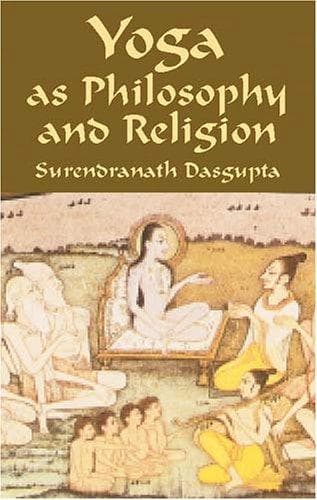
Yoga as philosophy and religionDasgupta, Surendranath
Religion
Yoga as philosophy and religion
Dasgupta, Surendranath
Hindu philosophy; Patañjali; Yoga
After having secured stability in the Āsanas the prāṇāyāmas should be
attempted. The pause that comes after a deep inhalation and that after a
deep exhalation are each called a prāṇāyāma; the first is external, the
second internal. There is, however, a third mode, by means of which,
since the lungs are neither too much dilated nor too much contracted,
total restraint is obtained; cessation of both these motions takes place
by a single effort, just as water thrown on a heated stone shrivels up
on all sides.
These can be regulated by calculating the strength of inhalation and
exhalation through space, time or number. Thus as the breathing becomes
slower, the space that it occupies also becomes smaller and smaller.
Space again is of two kinds, internal and external. At the time of
inhalation, the breath occupies internal space, which can be felt even
in the soles of hand and feet, like the slight touch of an ant. To try
to feel this touch along with deep inhalation serves to lengthen the
period of cessation of breathing. External space is the distance from
the tip of the nose to the remotest point at which breath when inhaled
can be felt, by the palm of the hand, or by the movement of any light
substance like cotton, etc., placed there. Just as the breathing becomes
slower and slower, the distances traversed by it also becomes smaller
and smaller. Regulations by time is seen when the attention is fixed
upon the time taken up in breathing by moments, a moment (_kshaṇa_) is
the fourth part of the twinkling of the eye. Regulation by time thus
means the fact of our calculating the strength of the prāṇāyāma the
moments or kshaṇas spent in the acts of inspiration, pause and
respiration. These prāṇāyāmas can also be measured by the number of
moments in the normal duration of breaths. The time taken by the
respiration and expiration of a healthy man is the same as that measured
by snapping the fingers after turning the hand thrice over the knee and
is the measure of duration of normal breath; the first attempt or
udghāta called mild is measured by thirty-six such mātrās or measures;
when doubled it is the second udghāta called middling; when trebled it
is the third udghāta called intense. Gradually the Yogin acquires the
practice of prāṇāyāma of long duration, by daily practice increasing in
succession from a day, a fortnight, a month, etc. Of course he proceeds
first by mastering the first udghāta, then the second, and so on until
the duration increases up to a day, a fortnight, a month as stated.
There is also a fourth kind of prāṇāyāma transcending all these stages
of unsteady practice, when the Yogin is steady in his cessation of
breath. It must be remembered, however, that while the prāṇāyāmas are
being practised, the mind must be fixed by dhyāna and dhāraṇā to some
object external or internal, without which these will be of no avail for
the true object of Yoga. By the practice of prāṇāyāma, mind becomes fit
Public-domain text, read in full here on John Shaqi.
Reviews
Reviews
No reviews yet
Be the first to share your thoughts on this work.
Elsewhere in the archive
Join the Discussion
Join the discussion
Sign in to leave a comment or review.
Sign InorCreate an account