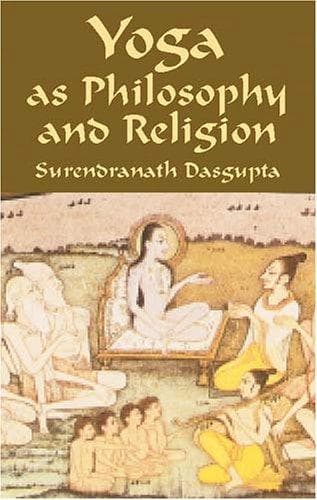
Yoga as philosophy and religionDasgupta, Surendranath
Religion
Yoga as philosophy and religion
Dasgupta, Surendranath
Hindu philosophy; Patañjali; Yoga
Now one of the means of attaining Yoga is Īśvarapraṇidhāna, or worship
of God. This word, according to the commentators, is used in two senses
in the first and the second books of the Pātañjala Yoga aphorisms. In
the first book it means love or devotion to God as the one centre of
meditation, in the second it is used to mean the abnegation of all
desires of the fruits of action to Īśvara, and thus Īśvarapraṇidhāna in
this sense is included under kriyāyoga. This dedication of all fruits of
action to Īśvara, purifies the mind and makes it fit for Yoga and is
distinguished from the Īśvarapraṇidhāna of the first book as the bhāvanā
of praṇava and Īśvara in this that it is connected with actions and the
abnegation of their fruits, whereas the latter consists only in keeping
the mind in a worshipful state towards Īśvara and his word or name
praṇava.
By devotion (bhakti) Īśvara is drawn towards the devotee through his
nirmāṇa citta of pure sattva and by his grace he removes all
obstructions of illness, etc., described in I. 30, 31, and at once
prepares his mind for the highest realisation of his own absolute
independence. So for a person who can love and adore Īśvara, this is the
easiest course of attaining samādhi. We can make our minds pure most
easily by abandoning all our actions to Īśvara and attaining salvation
by firm and steady devotion to Him. This is the sphere of bhaktiyoga by
which the tedious complexity of the Yoga process may be avoided and
salvation speedily acquired by the supreme grace of Īśvara.
This means is not, however, distinct from the general means of Yoga,
viz. abhyāsa and vairāgya, which applies to all stages. For here also
abhyāsa applies to the devotion of Īśvara as one supreme truth and
vairāgya is necessarily associated with all true devotion and adoration
of Īśvara.
This conception of Īśvara differs from the conception of Īśvara in the
Rāmānuja system in this that there prakṛti and purusha, acit and cit,
form the body of Īśvara, whereas here Īśvara is considered as being only
a special purusha with the aforesaid powers.
In this system Īśvara is not the superintendent of prakṛti in the sense
of the latter’s remaining in him in an undifferentiated way, but is
regarded as the superintendent of dharma and adharma, and his agency is
active only in the removal of obstacles, thereby helping the
evolutionary process of prakṛti.
Thus Īśvara is distinguished from the Īśvara of Saṅkara Vedānta in this
that there true existence is ascribed only to Īśvara, whereas all other
forms and modes of Being are only regarded as illusory.
Public-domain text, read in full here on John Shaqi.
Reviews
Reviews
No reviews yet
Be the first to share your thoughts on this work.
Elsewhere in the archive
Join the Discussion
Join the discussion
Sign in to leave a comment or review.
Sign InorCreate an account