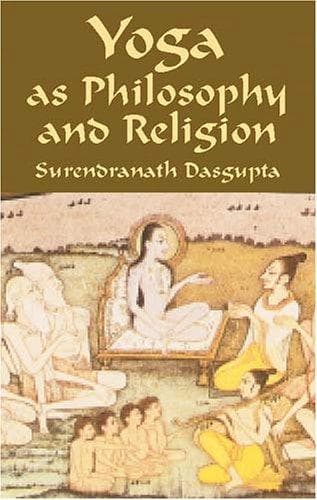
Yoga as philosophy and religionDasgupta, Surendranath
Religion
Yoga as philosophy and religion
Dasgupta, Surendranath
Hindu philosophy; Patañjali; Yoga
From what we have seen above it is clear that the main stress of the
Yoga philosophy is on the method of samādhi. The knowledge that can be
acquired by it differs from all other kinds of knowledge, ordinary
perception, inference, etc., in this that it alone can bring objects
before our mental eye with the clearest and most unerring light of
comprehensibility in which the true nature of the thing is at once
observed. Inferences and the words of scriptures are based on concepts
or general notions of things. For the teaching of the Vedas is
manifested in words; and words are but names, terms or concepts formed
by noting the general similarities of certain things and binding them
down by a symbol. All deductive inferences are also based upon major
propositions arrived at by inductive generalisations; so it is easy to
see that all knowledge that can be acquired by them is only generalised
conceptions. Their process only represents the method by which the mind
can pass from one generalised conception to another; so the mind can in
no way attain the knowledge of real things, absolute species, which are
not the genus of any other thing; so inference and scripture can only
communicate to us the nature of the agreement or similarity of things
and not the real things as they are. Ordinary perception also is not of
much avail here, since it cannot bring within its scope subtle and fine
things and things that are obstructed from the view of the senses. But
samādhi has no such limitations and the knowledge that can be attained
by it is absolutely unobstructed, true and real in the strictest sense
of the terms.
Public-domain text, read in full here on John Shaqi.
Reviews
Reviews
No reviews yet
Be the first to share your thoughts on this work.
Elsewhere in the archive
Join the Discussion
Join the discussion
Sign in to leave a comment or review.
Sign InorCreate an account