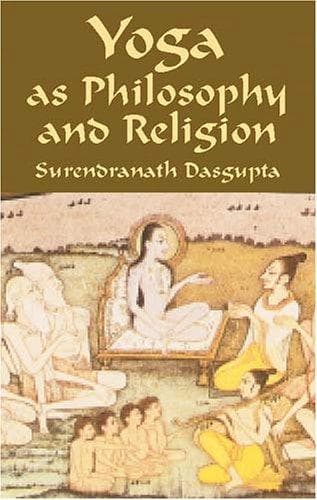
Yoga as philosophy and religionDasgupta, Surendranath
Religion
Yoga as philosophy and religion
Dasgupta, Surendranath
Hindu philosophy; Patañjali; Yoga
We have just seen that Sāṃkhya does not admit the existence of God, and
considers that salvation can be obtained only by a steady perseverance
in philosophical thinking, and does not put emphasis on the practical
exercises which are regarded as essential by the Yoga. One other point
of difference ought to be noted with regard to the conception of avidyā.
According to Yoga, avidyā, as we have already explained it, means
positive untrue beliefs such as believing the impure, uneternal, sorrow,
and non-self to be the pure eternal, pleasure and the self respectively.
With Sāṃkhya, however, avidyā is only the non-distinction of the
difference between prakṛti and purusha. Both Sāṃkhya and Yoga admit that
our bondage to prakṛti is due to an illusion or ignorance (avidyā), but
Sāṃkhya holds the akhyāti theory which regards non-distinction of the
difference as the cause of illusion whereas the Yoga holds the
anyathākhyāti theory which regards positive misapprehension of the one
as the other to be the cause of illusion. We have already referred to
the difference in the course of the evolution of the categories as held
by Sāṃkhya and Yoga. This also accounts for the difference between the
technical terms of prakṛti, vikṛti and prakṛti-vikṛti of Sāṃkhya and the
viśesha and aviśesha of the Yoga. The doctrine of dharma, lakshaṇa and
avasthāpariṇāma, though not in any way antagonistic to Sāṃkhya, is not
so definitely described as in the Yoga. Some scholars think that Sāṃkhya
did not believe in atoms as Yoga did. But though the word paramāṇu has
not been mentioned in the _Kārikā_, it does not seem that Sāṃkhya did
not believe in atoms; and we have already noticed that Bhikshu considers
the word sūkshma in _Kārikā_ 39 as referring to the atoms. There are
also slight differences with regard to the process involved in
perception and this has been dealt with in my _Yoga philosophy in
relation to other Indian systems of thought_.[43] On almost all other
fundamental points Sāṃkhya and Yoga are in complete agreement.
CHAPTER XV
MATTER AND MIND
In conclusion it may be worth while saying a few words as to theories of
the physical world supplementary to the views that have already been
stated above.
Public-domain text, read in full here on John Shaqi.
Reviews
Reviews
No reviews yet
Be the first to share your thoughts on this work.
Elsewhere in the archive
Join the Discussion
Join the discussion
Sign in to leave a comment or review.
Sign InorCreate an account