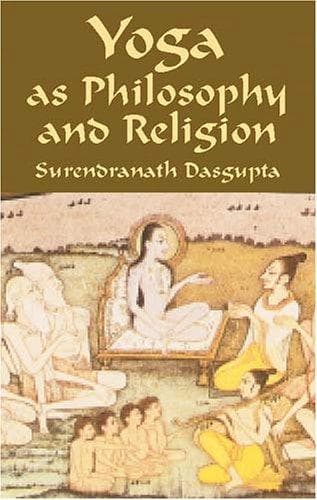
Yoga as philosophy and religionDasgupta, Surendranath
Religion
Yoga as philosophy and religion
Dasgupta, Surendranath
Hindu philosophy; Patañjali; Yoga
Gross matter, as the possibility of sensation, has been divided into
five classes, according to their relative grossness, corresponding to
the relative grossness of the senses. Some modern investigators have
tried to understand the five bhūtas, viz. ākāśa, marut, tejas, ap and
kshiti as ether, gaseous heat and light, liquids and solids. But I
cannot venture to agree when I reflect that solidity, liquidity and
gaseousness represent only an impermanent aspect of matter. The division
of matter from the standpoint of the possibility of our sensations, has
a firm root in our nature as cognising beings and has therefore a better
rational footing than the modern chemical division into elements and
compounds, which are being daily threatened by the gradual advance of
scientific culture. This carries with it no fixed and consistent
rational conception as do the definitions of the ancients, but is a mere
makeshift for understanding or representing certain chemical changes of
matter and has therefore a merely relative value.
There are five aspects from which gross matter can be viewed. These are
(1) sthūla (gross), (2) svarūpa (substantive), (3) sūkshma (subtle), (4)
anvaya (conjunction), (5) arthavattva (purpose for use). The sthūla or
gross physical characteristics of the bhūtas are described as follows:—
Qualities of Earth—Form, heaviness, roughness, obstruction, stability,
manifestation (vṛtti), difference, support, turbidity, hardness and
enjoyability.
Ap—Smoothness, subtlety, clearness, whiteness, softness, heaviness,
coolness, conservation, purity, cementation.
Tejas—Going upwards, cooking, burning, light, shining, dissipating,
energising.
Vāyu—Transverse motion, purity, throwing, pushing, strength, movability,
want of shadow.
Ākāśa—Motion in all directions, non-agglomeration, non-obstruction.
These physical characteristics are distinguished from the aspects by
which they appeal to the senses, which are called their svarūpas. Earth
is characterised by gandha or smell, ap by rasa or taste, tejas by rūpa,
etc. Looked at from this point of view, we see that smell arises by the
contact of the nasal organ with the hard particles of matter; so this
hardness or solidity which can so generate the sensibility of gandha, is
said to be the svarūpa of kshiti. Taste can originate only in connection
with liquidity, so this liquidity or sneha is the svarūpa or nature of
ap. Light—the quality of visibility—manifests itself in connection with
heat, so heat is the svarūpa of fire. The sensibility of touch is
generated in connection with the vibration of air on the epidermal
surface; so this vibratory nature is the svarūpa of air.
The sensibility to sound proceeds from the nature of
obstructionlessness, which belongs to ākāśa, so this obstructionlessness
is the svarūpa of ākāśa.
Public-domain text, read in full here on John Shaqi.
Reviews
Reviews
No reviews yet
Be the first to share your thoughts on this work.
Elsewhere in the archive
Join the Discussion
Join the discussion
Sign in to leave a comment or review.
Sign InorCreate an account