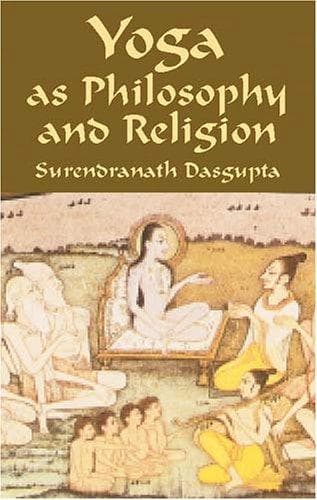
Yoga as philosophy and religionDasgupta, Surendranath
Religion
Yoga as philosophy and religion
Dasgupta, Surendranath
Hindu philosophy; Patañjali; Yoga
There is another aspect by which the percepts and concepts are retained
(_dhāraṇa_) in the mind as saṃskāras, to be repeated or revealed again
in the mind as actual states. This is the tamas side of manas.
In connection with this we may mention ūha (positive argumentation),
apoha (negative argumentation) and tattvajñāna (logical conclusion)
which are the modes of different anuvyavasāyas of the manas. Will, etc.,
are to be included with these (_Yoga-varttikā_, II. 18). Looked at from
the point of view of cittas, these may equally be regarded as the
modifications of cittas.
The motives which sustain this process of outgoing activity are false
knowledge, and such other emotional elements as egoism, attachment,
aversion, and love of life. These emotional elements remain in the mind
in the germinal state as power alone; or they exist in a fully operative
state when a man is under the influence of any one of them; or they
alternate with others, such as attachment or aversion; or they may
become attenuated by meditation upon opposites. Accordingly they are
called respectively prasupta, udāra, vicchinna or tanu. Man’s minds or
cittas may follow these outgoing states or experiences, or gradually
remove those emotions which are commonly called afflictions, thus
narrowing their sphere and proceeding towards final release.
All the psychic states described above, viz. pramāṇa, viparyyaya, etc.,
are called either afflicted or unafflicted according as they are moved
towards outgoing activity or are actuated by the higher motive of
emancipation by narrowing the field of experiences gradually to a
smaller and smaller sphere and afterwards to suppress them altogether.
These two kinds of motives, one of afflictions that lead towards
external objects of attachment and aversion or love of life, and the
other which leads to striving for kaivalya, are the sole motives which
guide all human actions and psychic states.
They influence us whenever suitable opportunities occur, so that by the
study of the Vedas, self-criticism or right argumentation, or from the
instruction of good men, abhyāsa and vairāgya may be roused by vidyā.
Right knowledge and a tendency towards kaivalya may appear in the mind
even when a man is immersed in the afflicted states of outgoing
activity. So also afflicted states may appear when a man is bent upon or
far advanced in those actions which are roused by vidyā or the tendency
towards kaivalya.
Public-domain text, read in full here on John Shaqi.
Reviews
Reviews
No reviews yet
Be the first to share your thoughts on this work.
Elsewhere in the archive
Join the Discussion
Join the discussion
Sign in to leave a comment or review.
Sign InorCreate an account