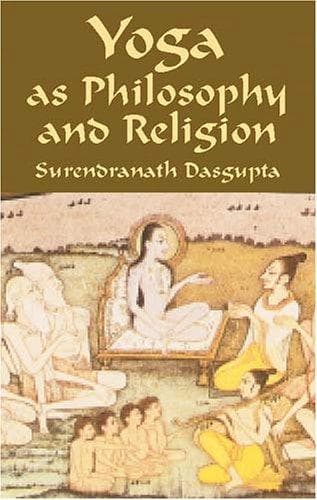
Yoga as philosophy and religionDasgupta, Surendranath
Religion
Yoga as philosophy and religion
Dasgupta, Surendranath
Hindu philosophy; Patañjali; Yoga
Thus memory comes when the percepts already known and acquired are kept
in the mind in the form of impressions and are manifested by the
udbodhakas or associative manifestors. It differs from perceptions in
this that the latter are of the nature of perceiving the unknown and
unperceived, whereas the former serves to bring before the mind percepts
that have already been acquired. Memory is therefore of percepts already
acquired by real cognition, unreal cognition, imagination, sleep and
memory. It manifests itself in dreams as well as in waking states.
The relation between these states of mind and the saṃskāras is this that
their frequency and repetition strengthens the saṃskāras and thus
ensures the revival of these states.
They are all endowed with sukha (pleasure), duḥkha (pain) and moha
(ignorance). These feelings cannot be treated separately from the states
themselves, for their manifestations are not different from the
manifestation of the states themselves. Knowledge and feeling are but
two different aspects of the modifications of cittas derived from
prakṛti; hence neither can be thought separately from the other. The
fusion of feeling with knowledge is therefore here more fundamental than
in the modern tripartite division of mind.
In connection with this we are to consider the senses whose action on
the external world is known as “perceiving,” “grahaṇa,” which is
distinguished from “pratyaksha,” which means the effect of “perceiving,”
viz. perception. Each sense has got its special sphere of work, e.g.
sight is of the eye, and this is called their second aspect, viz.
svarūpa. Their third aspect is of “asmitā” or ego, which manifests
itself through the senses. Their fourth aspect is their characteristic
of guṇas, viz. that of manifestation (_prakāśa_), action (_kriyā_) and
retention (_sthiti_). Their fifth aspect is that they are set in motion
for purusha, his experiences and liberation.
It is indeed difficult to find the relation of manas with the senses and
the cittas. In more than one place manas is identified with cittas, and,
on the other hand, it is described as a sense organ. There is another
aspect in which manas is said to be the king of the cognitive and motor
senses. Looked at in this aspect, manas is possibly the directive side
of the ego by which it guides the cognitive and conative senses in the
external world and is the cause of their harmonious activity for the
experience of purusha. As a necessary attribute of this directive
character of manas, the power of concentration, which is developed by
prāṇāyāma, is said to belong to manas. This is the rajas side of manas.
There is another aspect of manas which is called the anuvyavasāya or
reflection, by which the sensations (ālocana) are associated,
differentiated, integrated, assimilated into percepts and concepts. This
is possibly the sāttvika side of manas.
Public-domain text, read in full here on John Shaqi.
Reviews
Reviews
No reviews yet
Be the first to share your thoughts on this work.
Elsewhere in the archive
Join the Discussion
Join the discussion
Sign in to leave a comment or review.
Sign InorCreate an account