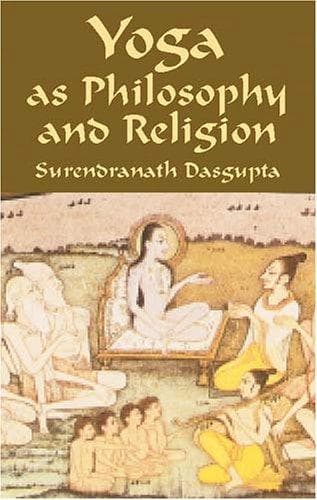
Yoga as philosophy and religionDasgupta, Surendranath
Religion
Yoga as philosophy and religion
Dasgupta, Surendranath
Hindu philosophy; Patañjali; Yoga
analytical view of the meaning of a sentence—an imaginary division of it
as into cases, verbs, etc.
_Abhihitānvayavada and Anvitābhidhānavāda._—This reminds us of the two
very famous theories about the relation of sentences to words, viz. the
“Abhihitānvayavāda” and the “Anvitābhidhānavāda.” The former means that
words themselves can express their separate meanings by the function
abhidhā or denotation; these are subsequently combined into a sentence
expressing one connected idea. The latter means that words only express
a meaning as parts of a sentence, and as grammatically connected with
each other; they only express an action or something connected with
action; in “sāmānaya”, “bring the cow”—“gām” does not properly mean
“gotva” but “ānayanānvitagotva,” that is, the bovine genus as connected
with bringing. We cannot have a case of a noun without some governing
verb and vice versa—(Sarvadarśana-saṃgraha, Cowell).
_The Yoga point of view._—It will be seen that strictly speaking the
Yoga view does not agree with any one of these views though it
approaches nearer to the Anvitābhidhāna view than to the Abhihitānvaya
view. For according to the Yoga view the idea of the sentence is the
only true thing; words only serve to manifest this idea but have
themselves no meaning. The division of a sentence into the component
word-conceptions is only an imaginary analysis—an afterthought.
_Confusion the cause of verbal cognition._—According to Patañjali’s view
verbal cognition proceeds only from a confusion of the letter-form
sounds (which are perceived in the sense of hearing), the śabda-sphoṭa
which is manifested in the buddhi, and the object which exists in the
external world. These three though altogether distinct from one another
yet appear to be unified on account of the saṅketa or sign, so that the
letter-form sounds, the śabda-sphoṭa, and the thing, can never be
distinguished from one another. Of course knowledge can arise even in
those cases where there is no actual external object, simply by virtue
of the manifesting power of the letter-form sounds. This saṅketa is
again defined as the confusion of words and their meanings through
memory, so that it appears that what a word is, so is its denoted
object, and what a denoted word is, so is its object. Convention is a
manifestation of memory of the nature of mutual confusion of words and
their meanings. This object is the same as this word, and this word is
the same as this object. Thus there is no actual unity of words and
their objects: such unity is imaginary and due to beginningless
tradition. This view may well be contrasted with Nyāya, according to
which the convention of works as signifying objects is due to the will
of God.
INDEX
_abhihitānvayavāda_, 186
abhiniveśa, 101, 104
_abhivyaktikāraṇa_, 133
abhyāsa, 100, 101, 126, 128, 129, 130, 138, 143, 149, 162, 177
Absorption, 102
Abstraction, 135, 136, 148, 154, 174
Accessories, 135, 137, 145
Public-domain text, read in full here on John Shaqi.
Reviews
Reviews
No reviews yet
Be the first to share your thoughts on this work.
Elsewhere in the archive
Join the Discussion
Join the discussion
Sign in to leave a comment or review.
Sign InorCreate an account