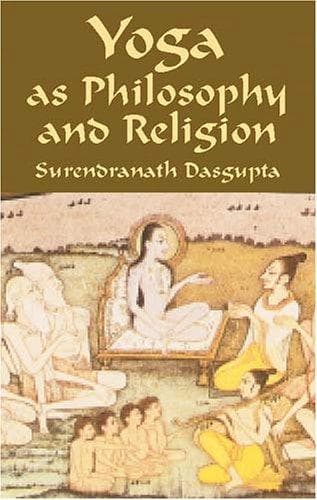
Yoga as philosophy and religionDasgupta, Surendranath
Religion
Yoga as philosophy and religion
Dasgupta, Surendranath
Hindu philosophy; Patañjali; Yoga
Nothing more than a superficial comparison with Fichte is here
intended. A large majority of the texts and the commentary literature
would oppose the attempts of all those who would like to interpret
Sāṃkhya-yoga on Fichtean lines.
Footnote 27:
_Tattvakaumudī_ on _Sāṃkhya-kārikā_, 25.
Footnote 28:
_Tattvavaiśāradī_, III. 41.
Footnote 29:
This was first pointed out by Dr. B. N. Seal in his _Physical,
Chemical and Mechanical Theories of the Ancient Hindus_ in Dr. P. C.
Ray’s _Hindu Chemistry_, Vol. II.
Footnote 30:
_Yoga-vārttika_, I. 45.
Footnote 31:
I have already said before that Bhikshu thinks that the guṇas (except
the all-pervading ones) may be compared to the Vaiśeshika atoms. See
_Yoga-vārttika_, III. 52.
Footnote 32:
Cf. _Vyāsa-bhāshya_—“_sabdādīnāṃ mūrttisamānajátīyānāṃ_,” IV. 14.
Footnote 33:
_Vyāsa-bhāshya_, II. 19.
Footnote 34:
_Vyāsa-bhāshya_, III. 13.
Footnote 35:
_Ibid._
Footnote 36:
Nahusha an earthly king became Indra the king of the gods by the
fruition of his virtues, but on account of gross misdeeds fell from
Heaven and was turned into a snake.
Footnote 37:
_Tattravaiśāradī_, IV, 3.
Footnote 38:
I have translated both citta and buddhi as mind. The word buddhi is
used when emphasis is laid on the intellective and cosmical functions
of the mind. The word citta is used when emphasis is laid on the
conservative side of mind as the repository of all experiences,
memory, etc.
Footnote 39:
If this is a Sāṃkhya doctrine, it seems clearly to be a case of Jaina
influence.
Footnote 40:
Compare Pañcaśikha, _svalpasaṇkaraḥ saparihāraḥ sapratyavamarshaḥ_,
_Tattvakaumudī_, 2.
Footnote 41:
Pratyaya is explained in _Yoga-vārttika_, II. 28, as _sampratyaya_ or
_prāmāṇyaniścaya_.
Footnote 42:
Yudhishṭhira led falsely Droṇa to believe that the latter’s son was
dead by inaudibly muttering that it was only an elephant having the
same name as that of his son that had died.
Footnote 43:
This book has, however, not yet been published.
Footnote 44:
Dr. Ray’s _Hindu Chemistry_, Vol. II, p. 81.
Footnote 45:
Public-domain text, read in full here on John Shaqi.
Reviews
Reviews
No reviews yet
Be the first to share your thoughts on this work.
Elsewhere in the archive
Join the Discussion
Join the discussion
Sign in to leave a comment or review.
Sign InorCreate an account