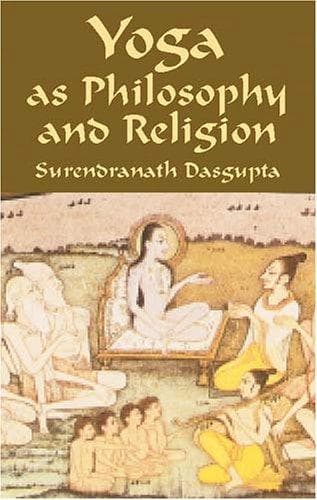
Yoga as philosophy and religionDasgupta, Surendranath
Religion
Yoga as philosophy and religion
Dasgupta, Surendranath
Hindu philosophy; Patañjali; Yoga
Now these guṇas take three different courses of development from the ego
or ahaṃkāra according to which the ego or ahaṃkāra may be said to be
sāttvika, rājasa and tāmasa. Thus from the sāttvika side of the ego by a
preponderance of sattva the five knowledge-giving senses, e.g. hearing,
sight, touch, taste and smell are derived. From the rajas side of ego by
a preponderance of rajas the five active senses of speech, etc., are
derived. From the tamas side of ego or ahaṃkāra by a preponderance of
tamas are derived the five tanmātras. From which again by a
preponderance of tamas the atoms of the five gross elements—earth,
water, fire, air and ether are derived.
In the derivation of these it must be remembered that all the three
guṇas are conjointly responsible. In the derivation of a particular
product one of the guṇas may indeed be predominant, and thus may bestow
the prominent characteristic of that product, but the other two guṇas
are also present there and perform their functions equally well. Their
opposition does not withhold the progress of evolution but rather helps
it. All the three combine together in varying degrees of mutual
preponderance and thus together help the process of evolution to produce
a single product. Thus we see that though the guṇas are three, they
combine to produce on the side of perception, the senses, such as those
of hearing, sight, etc.; and on the side of the knowable, the individual
tanmātras of gandha, rasa, rūpa, sparśa and śabda. The guṇas composing
each tanmātra again harmoniously combine with each other with a
preponderance of tamas to produce the atoms of each gross element. Thus
in each combination one class of guṇas remains prominent, while the
others remain dependent upon it but help it indirectly in the evolution
of that particular product.
CHAPTER IV
THE PROCESS OF EVOLUTION
The evolution which we have spoken of above may be characterised in two
ways: (1) That arising from modifications or products of some other
cause which are themselves capable of originating other products like
themselves; (2) That arising from causes which, though themselves
derived, yet cannot themselves be the cause of the origination of other
existences like themselves. The former may be said to be slightly
specialised (_aviśesha_) and the latter thoroughly specialised
(_viśesha_).
Public-domain text, read in full here on John Shaqi.
Reviews
Reviews
No reviews yet
Be the first to share your thoughts on this work.
Join the Discussion
Join the discussion
Sign in to leave a comment or review.
Sign InorCreate an account