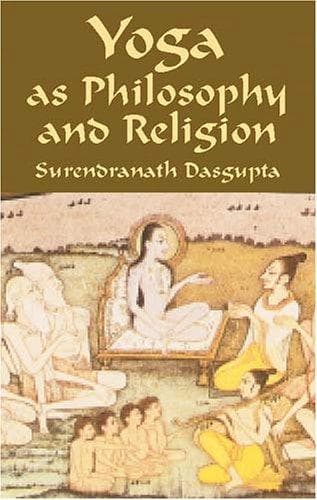
Yoga as philosophy and religionDasgupta, Surendranath
Religion
Yoga as philosophy and religion
Dasgupta, Surendranath
Hindu philosophy; Patañjali; Yoga
Each unit of time (_kshaṇa_) corresponding to this change of an atom of
its own unit of space is the unit-measure of change. This instantaneous
succession of time as discrete moments one following the other is the
notion of the series of moments or pure and simple succession. Now the
notion of these discrete moments is the notion of time. Even the notion
of succession is one that does not really exist but is imagined, for a
moment comes into being just when the moment just before had passed so
that they have never taken place together. Thus Vyāsa in III. 52, says:
“_kshaṇatatkramayornāsti vastusamāhāraḥ iti buddhisamāhāraḥ
muhūrttāhorātrātrādayaḥ_.” _Sa tvayaṃ kālaḥ vastuśūnyo’pi
buddhinirmāṇaḥ._ The moments and their succession do not belong to the
category of actual things; the hour, the day and night, are all
aggregates of mental conceptions. This time which is not a substantive
reality in itself, but is only a mental concept, represented to us
through linguistic usage, appears to ordinary minds as if it were an
objective reality.
So the conception of time as discrete moments is the real one, whereas
the conception of time as successive or as continuous is unreal, being
only due to the imagination of our empirical and relative consciousness.
Thus Vācaspati further explains it. A moment is real (_vastupatitaḥ_)
and is the essential element of the notion of succession. Succession
involves the notion of change of moments, and the moment is called time
by those sages who know what time is. Two moments cannot happen
together. There cannot be any succession of two simultaneous things.
Succession means the notion of change involving a preceding and a
succeeding moment. Thus there is only the present moment and there are
no preceding and later moments. Therefore there cannot be any union of
these moments. The past and the future moments may be said to exist only
if we speak of past and future as identical with the changes that have
become latent and others that exist potentially but are not manifested.
Thus in one moment, the whole world suffers changes. All these
characteristics are associated with the thing as connected with one
particular moment.[24]
So we find here that time is essentially discrete, being only the
moments of our cognitive life. As two moments never co-exist, there is
no succession or continuous time. They exist therefore only in our
empirical consciousness which cannot take the real moments in their
discrete nature but connects the one with the other and thereby imagines
either succession or continuous time.
Public-domain text, read in full here on John Shaqi.
Reviews
Reviews
No reviews yet
Be the first to share your thoughts on this work.
Join the Discussion
Join the discussion
Sign in to leave a comment or review.
Sign InorCreate an account