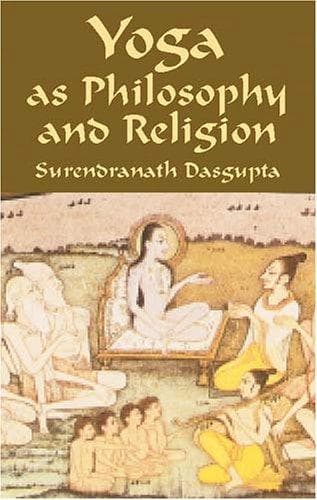
Yoga as philosophy and religionDasgupta, Surendranath
Religion
Yoga as philosophy and religion
Dasgupta, Surendranath
Hindu philosophy; Patañjali; Yoga
Nīlakaṇṭha in his commentary goes still further and says that a hard
substance called vajramaṇi also may be called living. Here we see that
the ancients had to a certain extent forestalled the discovery of Sir J.
C. Bose that the life functions differed only in degree between the
three classes, the inorganic, plants and animals.
These are all, however, only illustrations of dharma-pariṇāma, for here
there is no radical change in the elements themselves, the appearance of
qualities being due only to the different arrangement of the atoms of
the five gross elements. This change applies to the viśeshas only—the
five gross elements externally and the eleven senses internally. How the
inner microcosm, the manas and the senses are affected by
dharma-pariṇāma we shall see hereafter, when we deal with the psychology
of the Sāṃkhya-Pātañjala doctrine. For the present it will suffice to
say that the citta or mind also suffers this change and is modified in a
twofold mode; the patent in the form of the ideas and the latent, as the
substance itself, in the form of saṃskāras of subconscious impressions.
Thus the _Bhāshya_ says: “The mind has two kinds of characteristics,
perceived and unperceived. Those of the nature of ideas are perceived
and those inherent in the integral nature of it are unperceived. The
latter are of seven kinds and may be ascertained by inference. These are
cessation of mental states by samādhi, virtue and vice, subconscious
impressions, change, life-functioning, power of movement, and energy”
(III. 15).
This dharma-pariṇāma as we have shown it, is essentially different from
the satkāraṇavāda of the aviśeshas described above. We cannot close this
discussion about evolution without noticing the Sāṃkhya view of
causation.
We have seen that the Sāṃkhya-Pātañjala view holds that the effect is
already existent in the cause, but only in a potential form. “The
grouping or collocation alone changes, and this brings out the
manifestation of the latent powers of the guṇas, but without creation of
anything absolutely new or non-existent.” This is the true satkāryyavāda
theory as distinguished from the so-called satkāryyavāda theory of the
Vedāntists, which ought more properly to be called the satkāraṇavāda
theory, for with them the cause alone is true, and all effects are
illusory, being only impositions on the cause. For with them the
material cause alone is true, whilst all its forms and shapes are merely
illusory, whereas according to the Sāṃkhya-Pātañjala doctrine all the
appearances or effects are true and are due to the power which the
substance has of transforming itself into those various appearances and
effects _yogyatāvacchinnā dharmiṇaḥ śaktireva dharmaḥ_ (III. 14). The
operation of the concomitant condition or efficient cause serves only to
effect the passage of a thing from potency to actualisation.
Public-domain text, read in full here on John Shaqi.
Reviews
Reviews
No reviews yet
Be the first to share your thoughts on this work.
Elsewhere in the archive
Join the Discussion
Join the discussion
Sign in to leave a comment or review.
Sign InorCreate an account