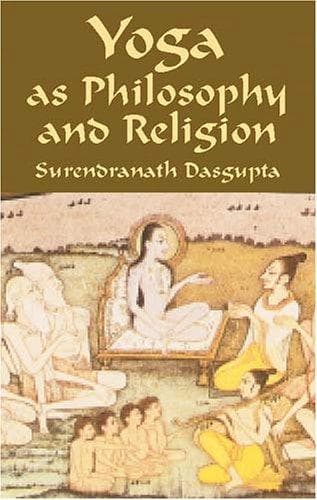
Yoga as philosophy and religionDasgupta, Surendranath
Religion
Yoga as philosophy and religion
Dasgupta, Surendranath
Hindu philosophy; Patañjali; Yoga
Everything in the phenomenal world is but a special collocation of the
guṇas; so that the change of collocation explains the diversity of
things. Considered from the point of view of the guṇas, things are all
the same, so excluding that, the cause of the diversity in things is the
power which the guṇas have of changing their particular collocations and
thus assuming various shapes. We have seen that the prakṛti unfolds
itself through various stages—the mahat called the great being—the
ahaṃkāra, the tanmātras called the aviśeshas. Now the liṅga at once
resolves itself into the ahaṃkāra and through it again into the
tanmātras. The ahaṃkāra and the tanmātras again resolve themselves into
the senses and the gross elements, and these again are constantly
suffering thousands of modifications called the dharma, lakshaṇa, and
avasthā-pariṇāma according to the definite law of evolution
(_pariṇāmakramaniyama_).
Now according to the Saṃkhya-Pātañjala doctrine, the śakti—power,
force—and the śaktimān—the possessor of power or force—are not different
but identical. So the prakṛti and all its emanations and modifications
are of the nature of substantive entities as well as power or force.
Their appearances as substantive entities and as power or force are but
two aspects, and so it will be erroneous to make any such distinction as
the substantive entity and its power or force. That which is the
substantive entity is the force, and that which is the force is the
substantive entity. Of course for all practical purposes we can indeed
make some distinction, but that distinction is only relatively true.
Thus when we say that earth is the substantive entity and the power
which it has of transforming itself into the produced form, lump, or jug
as its attribute, we see on the one hand that no distinction is really
made between the appearance of the earth as jug and its power of
transforming itself into the jug. As this power of transforming itself
into lump or jug, etc., always abides in the earth we say that the jug,
etc., are also abiding in the earth; when the power is in the potential
state, we say that the jug is in the potential state, and when it is
actualised, we say that the jug has been actualised. Looked at from the
tanmātric side, the earth and all the other gross elements must be said
to be mere modifications, and as such identical with the power which the
tanmātras have of changing themselves into them. The potentiality or
actuality of any state is the mere potentiality or actuality of the
power which its antecedent cause has of transforming itself into it.
CHAPTER VII
EVOLUTION AND CHANGE OF QUALITIES
Public-domain text, read in full here on John Shaqi.
Reviews
Reviews
No reviews yet
Be the first to share your thoughts on this work.
Elsewhere in the archive
Join the Discussion
Join the discussion
Sign in to leave a comment or review.
Sign InorCreate an account