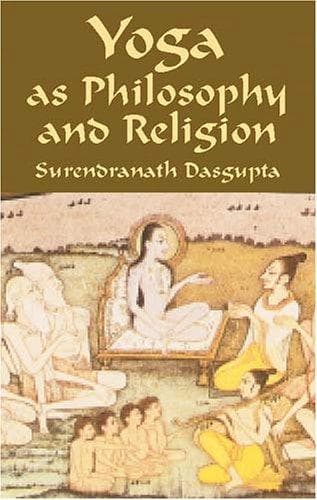
Yoga as philosophy and religionDasgupta, Surendranath
Religion
Yoga as philosophy and religion
Dasgupta, Surendranath
Hindu philosophy; Patañjali; Yoga
We have described avidyā and its special forms as the kleśas, from which
also proceed the actions virtuous and vicious, which in their turn again
produce as a result of their fruition, birth, life and experiences of
pleasure and pain and the vāsanās or residues of the memory of these
experiences. Again every new life or birth is produced from the
fructification of actions of a previous life; a man is made to perform
actions good or bad by the kleśas which are rooted in him, and these
actions, as a result of their fructification, produce another life and
its experiences, in which life again new actions are earned by virtue of
the kleśas, and thus the cycle is continued. When there is pralaya or
involution of the cosmical world-process the individual cittas of the
separate purushas return back to the prakṛti and lie within it, together
with their own avidyās, and at the time of each new creation or
evolution these are created anew with such changes as are due according
to their individual avidyās, with which they had to return back to their
original cause, the prakṛti, and spend an indivisible inseparable
existence with it. The avidyās of some other creation, being merged in
the prakṛti along with the cittas, remain in the prakṛti as vāsanās, and
prakṛti being under the influence of these avidyās as vāsanās creates as
modifications of itself the corresponding minds for the individual
purushas, connected with them before the last pralaya dissolution. So we
see that though the cittas had returned to their original causes with
their individual nescience (_avidyā_), the avidyā was not lost but was
revived at the time of the new creation and created such minds as should
be suitable receptacles for it. These minds (buddhi) are found to be
modified further into their specific cittas or mental planes by the same
avidyā which is manifested in them as the kleśas, and these again in the
karmāśaya, jāti, āyush and bhoga, and so on; the individual, however, is
just in the same position as he was or would have been before the
involution of pralaya. The avidyās of the cittas which had returned to
the prakṛti at the time of the creation being revived, create their own
buddhis of the previous creation, and by their connection with the
individual purushas are the causes of the saṃsāra or cosmic
evolution—the evolution of the microcosm, the cittas, and the macrocosm
or the exterior world.
Public-domain text, read in full here on John Shaqi.
Reviews
Reviews
No reviews yet
Be the first to share your thoughts on this work.
Elsewhere in the archive
Join the Discussion
Join the discussion
Sign in to leave a comment or review.
Sign InorCreate an account