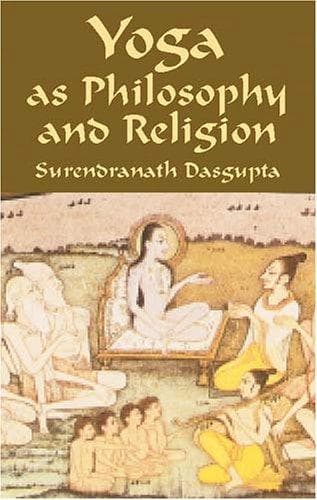
Yoga as philosophy and religionDasgupta, Surendranath
Religion
Yoga as philosophy and religion
Dasgupta, Surendranath
Hindu philosophy; Patañjali; Yoga
In this new creation, the creative agencies of God and avidyā are thus
distinguished in that the latter represents the end or purpose of the
prakṛti—the ever-evolving energy transforming itself into its
modifications as the mental and the material world; whereas the former
represents that intelligent power which abides outside the pale of
prakṛti, but removes obstructions offered by the prakṛti. Though
unintelligent and not knowing how and where to yield so as to form the
actual modifications necessary for the realisation of the particular and
specific objects of the numberless purushas, these avidyās hold within
themselves the serviceability of the purushas, and are the cause of the
connection of the purusha and the prakṛti, so that when these avidyās
are rooted out it is said that the purushārthatā or serviceability of
the purusha is at an end and the purusha becomes liberated from the
bonds of prakṛti, and this is called the final goal of the purusha.
The ethical problem of the Pātañjala philosophy is the uprooting of this
avidyā by the attainment of true knowledge of the nature of the purusha,
which will be succeeded by the liberation of the purusha and his
absolute freedom or independence—kaivalya—the last realisation of the
purusha—the ultimate goal of all the movements of the prakṛti.
This final uprooting of the avidyā with its vāsanās directly follows the
attainment of true knowledge called prajñā, in which state the seed of
false knowledge is altogether burnt and cannot be revived again. Before
this state, the discriminative knowledge which arises as the recognition
of the distinct natures of purusha and buddhi remains shaky; but when by
continual practice this discriminative knowledge becomes strengthened in
the mind, its potency gradually grows stronger and stronger, and roots
out the potency of the ordinary states of mental activity, and thus the
seed of false knowledge becomes burnt up and incapable of fruition, and
the impurity of the energy of rajas being removed, the sattva as the
manifesting entity becomes of the highest purity, and in that state
flows on the stream of the notion of discrimination—the recognition of
the distinct natures of purusha and buddhi—free from impurity. Thus when
the state of buddhi becomes almost as pure as the purusha itself, all
self-enquiry subsides, the vision of the real form of the purusha
arises, and false knowledge, together with the kleśas and the consequent
fruition of actions, ceases once for all. This is that state of citta
which, far from tending towards the objective world, tends towards the
kaivalya of the purusha.
Public-domain text, read in full here on John Shaqi.
Reviews
Reviews
No reviews yet
Be the first to share your thoughts on this work.
Elsewhere in the archive
Join the Discussion
Join the discussion
Sign in to leave a comment or review.
Sign InorCreate an account