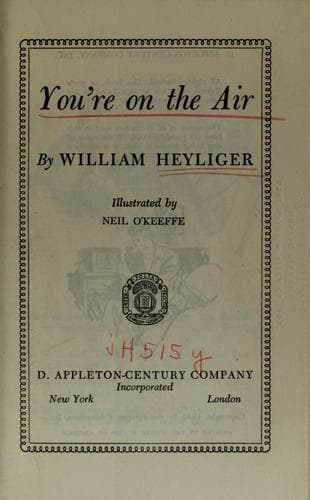
Dramatists -- Juvenile fiction; Radio acting -- Juvenile fiction; Radio broadcasting -- Juvenile fiction
Joe sat on a hard wooden bench. The loudspeaker went on and on, the only
sound, the only evidence of life on this floor. Once the elevator
stopped and a porter carried a kit of tools into one of the corridors.
The hard, lonely bench became harder, lonelier. Joe’s legs began to
shake and twitch. Ten minutes past two, and he was still alone in this
tomb of a fifth floor. So this was radio, was it? Two-fifteen. A
trickling river of sweat ran down his back.
The elevator stopped again and two men and a girl stepped out. One of
the men was short and stout. The other was tall, lean, and brisk, with a
penciling of black mustache across his upper lip. The short stout man
took some keys from his pocket and they walked past the bench. The girl
said: “Only six scheduled for to-day.” They went into Studio K.
Joe’s heart gave a smothering thud.
The door of the studio opened again. It was the girl. “Mr. Carlin? This
way, please.”
Joe’s feet were lifeless, without feeling. Studio K might have been any
one of the smaller studios he had seen from the fourth-floor
gallery—same microphone, same chairs along the walls, same control-room
at the far end. Behind the glass front of the control-room sat the stout
man and the brisk man with the microscopic mustache. The girl joined
them, going into the little room through a door at the side. It seemed
to Joe that all three glared out at him with malice. He dropped two of
his books on a chair.
The stout man spoke from the control-room through the two-way mike.
“What are you going to give us, Mr. Carlin?”
“A bit from—”
“The other side of the mike, please. You’re on the dead side.”
A badly confused Joe Carlin crossed over. “A bit—”
“A little closer. Don’t be nervous.”
But Joe’s nerves were tight clamoring strings. He opened the book and
found his page. “Robert Sherwood’s _Abe Lincoln in Illinois_.” He tried
desperately for control. “Abe is at the cabin of Mentor, the
school-teacher. Mentor remarks that Abe seems to do a lot of thinking
about death. Abe replies—” Joe struggled to create a drawling twang:
“‘I’ve had to, because it has always seemed to be so close to
me—always—as far back as I can remember. When I was no higher
than this table, we buried my mother. The milksick got her, poor
creature. I helped Paw make the coffin—whittled the pegs for it
with my own jackknife. We buried her in a timber clearing beside
my grandmother, old Betsy Sparrow. I used to go there often and
look at the place—used to watch the deer running over her grave
with their little feet. I never could kill a deer after that.
One time I catched hell from Paw because when he was taking aim
I knocked his gun up.’”[1]
Joe closed his copy of the play.
Public-domain text, read in full here on John Shaqi.
Reviews
Reviews
No reviews yet
Be the first to share your thoughts on this work.
Join the Discussion
Join the discussion
Sign in to leave a comment or review.
Sign InorCreate an account