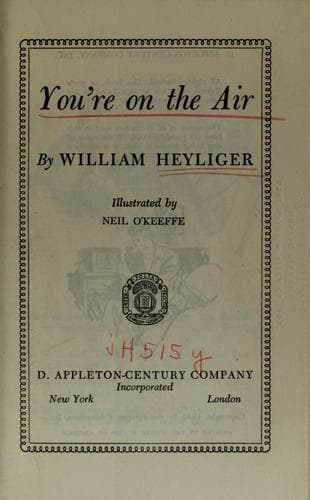
Dramatists -- Juvenile fiction; Radio acting -- Juvenile fiction; Radio broadcasting -- Juvenile fiction
Tony boomed genially. “Hello, Amby. Boy, how do you think of them? Good?
It’s a natural. How _do_ you think of them? You ought to be writing
script. You come up with ideas in each hand and every idea’s a honey.
But look, Amby. Isn’t this too good to waste? I mean, if it’s used now—
Sure; that’s the point. We should build up to it; set the stage for a
big smash. You were thinking of that? You’re absolutely right, Amby.
Your idea, then, is to put it on ice for two or three weeks? Great.
Couldn’t be better.” Tony put down the telephone.
“What do we do when he starts looking for typhoid?” Joe asked.
“In three weeks,” Tony chuckled, “he’ll think up a new brilliant and
forget this one.”
The account executive came back seeking data for an Everts-Hall client,
a soap manufacturer, who might make a cautious test of radio advertising
in this area. “He doesn’t want to spend any too much, Tony.”
“They never do,” Tony boomed and brought out platters. Joe listened to
show after show until it seemed that the world must be full of unsold
radio shows.
“How about a spot?” the executive asked.
“FKIP’s open at 4:15.” Tony brought out the Crosley ratings and there
was absorbed discussion of the competition the 4:15 spot faced and of
the ratings of the competing shows.
Joe ate a hurried sandwich at a drug-store counter. This was the part of
show business hidden from the public. Show business behind the scenes,
the inside stuff.
An actress and an actor named Mander were in the office with Tony when
Joe got back. Mander told a story and told it well. Tony threw back his
head and roared.
“Folks,” he said, “here’s where I move along.” The actress went out with
him. Their voices drifted back from the corridor.
Mander waited until they were gone. “Got a half-dollar that isn’t
working, Joe?” he asked quietly.
Joe dug into his pocket. The bread-and-butter hunt had followed him to
the Everts-Hall Agency.
“Dennis is making another _Mr. America_ show,” Mander said. “He’s
calling me in. They expect to sell the show.”
Joe thought: “They’re always expecting to sell a show—to-morrow.” The
day ran on, and in the late afternoon he tuned Tony’s radio for
_Bush-League Larry_.
Sonny Baker, as a brash, hot-headed young man beginning to make his mark
in professional baseball, gave a good, clear-cut performance. But what,
Joe asked himself in dismay, had happened to Pop Bartell? When Tony had
been putting the show together for the He people Pop had been
superb—mellowly in character. To-day he was jerky and uncertain as
though he were having trouble with his lines. What was it, the old
trouble? Was Pop still trying to maintain a false front of youth and
refusing to wear glasses?
Tony was beaming when he returned from FFOM. _Bush-League Larry_ was
clicking; he’d been told the _Journal_ was giving the show a nice notice
to-morrow. Joe, ready to start for home, lingered.
“Is this a regular stop on the rounds, Tony?” He had never made any of
the agencies a stop.
Public-domain text, read in full here on John Shaqi.
Reviews
Reviews
No reviews yet
Be the first to share your thoughts on this work.
Elsewhere in the archive
Join the Discussion
Join the discussion
Sign in to leave a comment or review.
Sign InorCreate an account