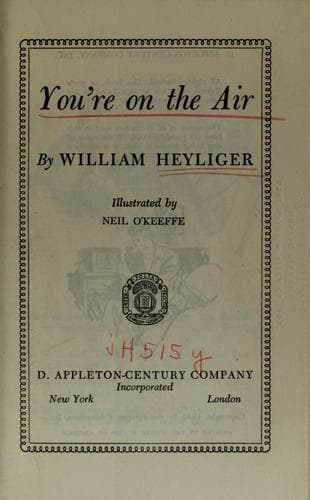
Dramatists -- Juvenile fiction; Radio acting -- Juvenile fiction; Radio broadcasting -- Juvenile fiction
He went back to Tony’s office. So it had been front, the pathetically
brave front of show business. Poor old Pop! A languidly contemptuous
climber had thrust him aside as a relic, and this is what he came to
after forty years of gallant trouping. This was show business. And
making the rounds was show business, and washing out your only shirt and
hanging it to dry overnight was show business, and Lucille Borden eating
out her heart behind a Munson counter was show business. Radio
small-time! Hunger and uncertainty!
He sat at Tony’s desk and thought of the day Vic Wylie had told him he’d
see things that would make him want to cry. The telephone rang fitfully
and he made note of the calls on Tony’s desk pad. A clock whirred the
five o’clock signal and Tony had not returned.
Slowly, his lips stiff, Joe took a pen from his pocket, wrote a note,
and left it on the desk:
Dear Tony: Pop was fronting; he cracked after he left here.
You’ve been swell to me, but this isn’t my game. I’ll be through
next Saturday. I’m sorry.
Joe
He pushed back the chair and stood in thought beside the desk. As slowly
as he had taken the pen from his pocket he reached for the telephone and
called Vic Wylie’s office.
“Will you give Vic a message for me, Miss Robb? We’ve been auditioning a
cast and—I guess I can’t take it. Tell him Pop Bartell’s been dropped
from the _Larry_ show. I’m throwing up my job.”
Miss Robb was dumfounded. “Tony told us he was pleased with you....”
“I know,” Joe said wearily. “Vic’ll understand.”
Office buildings were emptying, and Royal Street was a packed,
shuffling, slow-moving canyon. Joe moved along with the mass until he
came to the Thomas Carlin store. It was almost the closing hour, and a
lone customer waited for a clerk to wrap a purchase. The lights were on
and facets of radiance gleamed from the polished glass of show-cases and
the polished wood of shelves. To-day Joe saw the scene with a vision
that had been cleaned and washed—its bright cleanliness, its subdued
brilliance of display, its subtle breath of pride and courtesy and
alertness. The faces of all the clerks—strange that he had never noticed
them before: friendly faces that were not merely a friendly front. The
lone customer left. “Hi, Joe.” The clerks grinned at him. “Hi, boys.” He
grinned at them.
“Some new books came in to-day, Joe,” Mr. Fairchild announced.
“Not now,” said Joe. He added an explanation. “Something on my mind.”
“No!” Mr. Fairchild prodded his ribs. “They’ll toss you out of the
Jitterbug Union for that.”
It wasn’t a brilliant gag. As a gag, it would have been scorned by any
actor making the rounds. But it was good; it was homey.
The store closed, and Joe walked with his father to the parking lot. The
man pushed the key into the ignition lock and reached his foot for the
starter button.
“What is it, Joe? Trouble?”
“Not exactly.” Joe was still thinking of Pop Bartell. “I’m through at
the agency. I’d like to come into the store.”
Public-domain text, read in full here on John Shaqi.
Reviews
Reviews
No reviews yet
Be the first to share your thoughts on this work.
Elsewhere in the archive
Join the Discussion
Join the discussion
Sign in to leave a comment or review.
Sign InorCreate an account