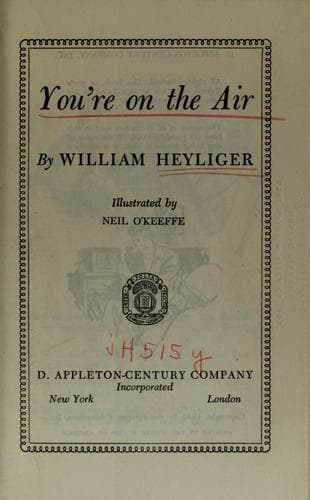
Dramatists -- Juvenile fiction; Radio acting -- Juvenile fiction; Radio broadcasting -- Juvenile fiction
Amby gulped coffee. “Sure Royal listens. Because he’s a great pal of
mine he might give you a low-down. He’d say: ‘Joe, you’re not ready; you
need more experience.’ So what? You’d come back here where you could get
experience. That’s why small-time radio pays in experience; you can’t
get it any place else. Didn’t Colonel Stoopnagle come out of an upstate
New York station? Ambrose Carver’s your agent, Joe, and Ambrose Carver’s
telling you.”
“Suppose I go on a five-a-week commercial?”
“Now you’re talking something else. That means a sponsor. Five dollars a
show.”
Joe’s finger drew a slow diagram on the table. “Sonny Baker was on a
commercial five-a-week. He also had two once-a-week commercials. How
much did he earn?”
“Maybe thirty-five dollars.”
Joe stood up. “And he’s what the _Journal_ calls a local radio star.
Lucille Borden and Archie Munn have been around a long time. They worked
to-day for nothing. If that’s radio, you can have it.”
Amby’s hand went up to the foppish little mustache. “You’re not
quitting, Joe,” he said softly. “To-day you cut your first platter. You
heard the playback. You’re not going to forget listening to your own
voice. Come back to FKIP.”
“What for?”
“To look around a studio; to see another mike.” Amby picked up the
check. “You’re not quitting, Joe. You can’t.”
The boy bit his lips.
“My office,” Amby announced briskly. “About noon to-morrow.”
Riding home on a Northend bus, Joe stared out at passing corners and saw
none of them. Amby was right. It got into you. You took a beating and
came back for more.
“Joe,” his mother drawled, “let me see what real radio money looks
like.”
The truth had to be told. “We get paid only if a show has a sponsor.”
Tom Carlin laid down his newspaper. “What’s that? Didn’t you say there
was a scale of twenty-one dollars...?”
“My mistake,” said Joe, expressionless. “The scale is only for big-time
stations. We take our pay in experience.”
“Humph! I pay my clerks every Saturday.”
“This is radio,” said Joe, and went upstairs to wash.
Anger grew in the man. “Kate, I don’t like this. Apparently the station
gets a lot of entertainment for nothing. I don’t like to see Joe
exploited....”
“Is it exploitation,” Kate Carlin asked quietly, “or a condition radio
hasn’t yet solved? It must have been a shock to him. He’s taking it
well.”
“Sometimes,” Tom Carlin said at last, “I wonder if you’re very wise or
whether you’re spoiling him.” He found Joe in the bathroom. “You may
need a little money,” he said, and handed his son five dollars.
Emotion made Joe’s voice gruff. “Dad, you’re—you’re tops.”
Next morning some cash in his pocket raised his spirits and youth’s
eternal hope flowed in him again. At noon he was on the sixth floor of
the McCoy Building. Amby’s office door was locked. To-day, instead of
waiting, he went back to the elevators.
“Seen Carver?” he asked.
“Carver’s been in and gone out,” the operator told him.
Public-domain text, read in full here on John Shaqi.
Reviews
Reviews
No reviews yet
Be the first to share your thoughts on this work.
Join the Discussion
Join the discussion
Sign in to leave a comment or review.
Sign InorCreate an account