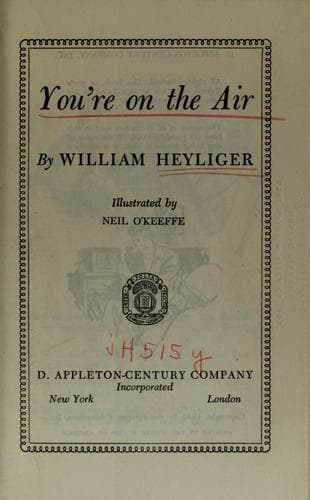
Dramatists -- Juvenile fiction; Radio acting -- Juvenile fiction; Radio broadcasting -- Juvenile fiction
Wylie’s elbows were on the table; his hands ravaged his hair. “Love,” he
groaned. “A two o’clock love serial. The air lousy with love shows in
the afternoon and Munson wants to toss in another one. A sure
plopperoo.” A waitress set down rolls and butter, and the producer
looked up. His eyes cleared. “You’ll get used to me talking to myself,”
he said to Joe and broke a roll.
Joe burned with curiosity. “Why does Munson want another show? He’s got
_Miss America and What She’ll Wear_....”
Wylie jabbed a wad of roll into his mouth. “That’s going off.”
“But all the women in our end of town—”
“We know the ratings, kid; we can tell you just how many listeners the
show grabs. But it isn’t bringing Munson business. A sponsored show is
advertising. It must produce. Not only listeners—business. If it doesn’t
bring in the boxtops, it lays an egg. That’s radio.”
Learning, Joe thought; learning every day. And then his thoughts were
back in the book department of his father’s store. Thomas Carlin
Presents.... He had based so much on the Munson show! Something in him
crystallized to conviction. Clothing was only clothing, but books were
romance and adventure. You could always sell romance and adventure.
There was only one question—how?
“Mr. Wylie, why does one show bring in the boxtops while another show
fails?”
“Kid, National or Columbia will pay a fortune to the man who can answer
that.” Wylie opened the brief-case and laid a script on the table. It
was the _Sue Davis Against the World_ script.
“You want me to read?” Joe asked, incredulous. His glance swept the
restaurant; tables, diners, waitresses. “Here?”
Wylie’s hands were brusque, impatient. “I’ve heard a trouper speak his
lines from a hospital bed. If you live that scene you won’t be Joe
Carlin reading to Vic Wylie in a restaurant. You’ll be Dick Davis
talking to his mother.”
Joe read. Wylie picked him up on the first sentence; the sweating agony
started. The supper hour passed and restaurant tables emptied, but at
the last table a man whose hair had become wild goaded and harried a boy
who tried to do miracles with his voice. The sugar bowl was upset and
blocks of sugar, unnoticed, lay strewn across the cloth. Joe, draining a
water-glass in a momentary respite, thought of something he had read in
high school: “Genius is the infinite capacity for taking pains.”
Sometimes the producer, frenzied, swooped on the accent of a word,
sometimes the cadence of a phrase. A shade of difference, a mere shade.
Often that was all Vic Wylie asked.
A porter came to the back of the restaurant with mops and pails. The
producer, hearing the clatter of chairs being lifted from the floor and
stacked on tables, shook his head as though to clear it of a mist,
stared at the spilled sugar, and was all at once quiet, inert.
“What time is it, kid?”
“Eleven-thirty.”
“A long day.” Vic Wylie put the script back in the leather case.
Public-domain text, read in full here on John Shaqi.
Reviews
Reviews
No reviews yet
Be the first to share your thoughts on this work.
Join the Discussion
Join the discussion
Sign in to leave a comment or review.
Sign InorCreate an account