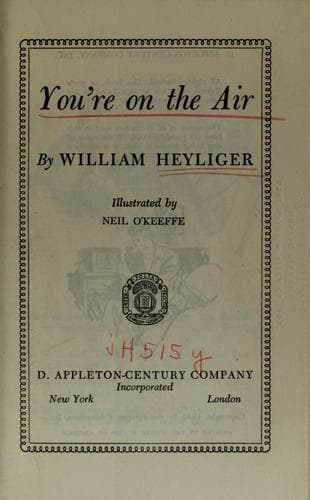
Dramatists -- Juvenile fiction; Radio acting -- Juvenile fiction; Radio broadcasting -- Juvenile fiction
Royal Street swallowed him and hurried him along with the crowd. Thomas
Carlin Presents To-day’s Book! He’d always felt there was a way for his
father to put on a broadcast and sell books. The movies did a selling
stunt every day. COMING ATTRACTIONS, and then half a dozen shots from
next week’s picture. The trick was to dramatize a scene from a book and
make people want to read the whole book. Vic probably wouldn’t use him
until next Monday’s show. He had almost a whole week.
The Thomas Carlin store was busy with men and women from the tall office
buildings, shopping during the lunch hour. One of the clerks raised a
cupped hand to his lips and Joe shook his head. No; he wasn’t back on
the air. His father was out.
“I want a book,” he said eagerly to Mr. Fairchild, his father’s
assistant. “I don’t care whether it’s an old book or a new book, but it
must be a good book with lots of action.”
“The jitterbug influence,” Mr. Fairchild smiled.
Joe’s hands made an impatient gesture. “Life. Something you can feel.
The McCoy.” Vic Wylie might have been speaking.
“Something—dramatic?” the man asked with a shrewd glance.
Joe went blank. He didn’t want to say anything about this until he saw
how it worked out. Mr. Fairchild took a book down from a shelf; the
telephone rang, and he had to go to the office. Joe made his escape,
winking at the clerks as he passed out toward the street.
The next three days were busy days. He was making a show. A book to read
and one particular scene to be picked for dramatization. What scene?
Chapter Eight offered a scene tense and climactic. But the action called
for four characters. Four were too many—a twenty-dollar cast. There was
a scene in Chapter Two between the lead and the heavy. Was it strong
enough? He walked the floor of his room, reading the passage aloud.
Perhaps that run in Chapter Nine with three characters.... Sometimes his
brain grew bewildered. He thought of Curt Lake sweating, and swearing,
and knocking out a new script under pressure the day his throat had gone
bad.
There were interruptions—lunch, the _Sue Davis_ broadcast, the family
dinner in the evening. But even as he described Sonny Baker or told of
Amby Carver’s rout, his mind was upstairs with the book. It would have
to be the scene from Chapter Two.
He worked behind the closed door of his room and rattled a portable
typewriter. He knew the mechanics of writing script, and the dialogue of
the scene was before him on the printed pages. The first two sheets of
script spun out of the typewriter. Then Joe ran into a passage in the
book that analyzed the thought passing through a character’s mind. How
did you get a character’s thoughts into a script? Radio had to be
dialogue. He wrote, and tore up what he had written, and wrote again. He
gave up in despair and fooled with a cross-word puzzle. He pushed that
aside and went back to writing. Nothing would jell. He tried talking the
scene aloud.
Kate Carlin cried: “Joe, are you all right?”
Public-domain text, read in full here on John Shaqi.
Reviews
Reviews
No reviews yet
Be the first to share your thoughts on this work.
Elsewhere in the archive
Join the Discussion
Join the discussion
Sign in to leave a comment or review.
Sign InorCreate an account