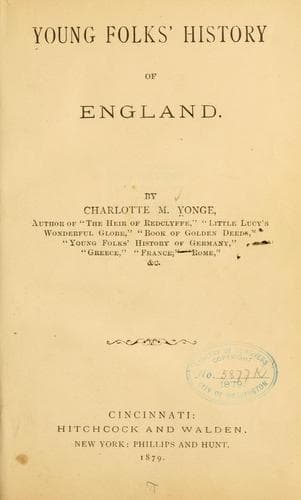
Young Folks' History of EnglandYonge, Charlotte M. (Charlotte Mary)
History
Young Folks' History of England
Yonge, Charlotte M. (Charlotte Mary)
Great Britain -- History -- Juvenile literature
William Pitt, son of Lord Chatham, was Prime Minister. He thought
that the Roman Catholics in England ought to have the same rights as
the king's other subjects, and not be hindered from being members of
Parliament, judges, or, indeed, from holding any office, and he wanted
to bring a bill into Parliament for this purpose. But the king thought
that for him to consent would be contrary to the oath he had sworn
when he was crowned, and which had been drawn up when William of
Orange came over. Nothing would make George III. break his word, and
he remained firm, though he was so harassed and distressed that he
fell ill, and lost the use of his reason for a time. There were
questions whether the regency--that is, the right to act as king--
should be given to the son, who, though his heir, was so unlike him,
when he recovered; and there was a great day of joy throughout the
nation, when he went in state to St. Paul's Cathedral to return thanks.
In the meantime, terrible troubles were going on in France. Neither
the kings nor nobles had, for ages past, any notion of their proper
duties to people under them, but had ground them down so hard that at
last they could bear it no longer; and there was a great rising up
throughout the country, which is known as the French Revolution. The
king who was then reigning was a good and kind man, Louis XVI., who
would gladly have put things in better order; but he was not as wise
or firm as he was good, and the people hated him for the evil doings
of his forefathers. So, while he was trying to make up his mind what
to do, the power was taken out of his hands, and he, with his wife,
sister, and two children, were shut up in prison. An evil spirit
came into the people, and made them believe that the only way to keep
themselves free would be to get rid of all who had been great people
in the former days. So they set up a machine for cutting off heads,
called the guillotine, and there, day after day, nobles and priests,
gentlemen and ladies--even the king, queen, and princess, were brought
and slain. The two children were not guillotined, but the poor little
boy, only nine years old, was worse off than if he had been, for the
cruel wretches who kept him called him the wolf-cub, and said he was
to be got rid of, and they kept him alone in a dark, dirty room, and
used him so ill that he pined to death. Many French gentry and
clergymen fled to England, and there were kindly treated and helped
to live; and the king's brother, now the rightful king himself, found
a home there too.
Public-domain text, read in full here on John Shaqi.
Reviews
Reviews
No reviews yet
Be the first to share your thoughts on this work.
Elsewhere in the archive
Join the Discussion
Join the discussion
Sign in to leave a comment or review.
Sign InorCreate an account