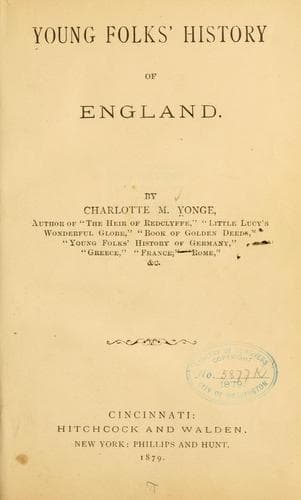
Young Folks' History of EnglandYonge, Charlotte M. (Charlotte Mary)
History
Young Folks' History of England
Yonge, Charlotte M. (Charlotte Mary)
Great Britain -- History -- Juvenile literature
In the meantime, the war went on between America and England, year
after year; and the Americans became trained soldiers and got the
better, so that George III. was advised to give up his rights over
them. Old Lord Chatham, his grandfather's minister, who had long
been too sick and feeble to undertake any public business, thought
it so bad for the country to give anything up, that he came down to
the House of Lords to make a speech against doing so; but he was not
strong enough for the exertion, and had only just done speaking when
he fainted away, and his son, William Pitt, was called out of the
House of Commons to help carry him away to his coach. He was taken
home, and died in a few day's time.
The war went on, but when it had lasted seven years, the English felt
that peace must be made; and so George III. gave up his rights to all
that country that is called the United States of America. The United
States set up a Government of their own, which has gone on ever since,
without a king, but with a President who is freshly chosen every four
years, and for whom every citizen has a vote.
As if to make up for what was lost in the West, the English were
winning a great deal in the East Indies, chiefly from a great prince
called Tipoo Sahib, who was very powerful, and at one time took a
number of English officers prisoners and drove them to his city of
Seringapatam, chained together in pairs, and kept them half starved
in a prison, where several died; but he was defeated and killed.
They were set free by their countrymen, after nearly two years of
grievous hardship.
CHAPTER XLIV.
GEORGE III. A.D. 1785--1810.
The chief sorrow of George III. was that his eldest sons were wild,
disobedient young men. George, Prince of Wales, especially, was very
handsome, and extremely proud of his own beauty. He was called the
First Gentleman in Europe, and set the fashion in every matter of
taste; but he spent and wasted money to a shameful amount, and was
full of bad habits; besides which, he used to set himself in every
way in his power to vex and contradict his father and mother, whom
he despised for their plain simple ways and their love of duty.
The next two brothers--Frederick, Duke of York, and William, Duke
of Clarence--had also very bad habits; but they went astray from
carelessness, and did not wilfully oppose their father, like their
eldest brother.
Public-domain text, read in full here on John Shaqi.
Reviews
Reviews
No reviews yet
Be the first to share your thoughts on this work.
Elsewhere in the archive
Join the Discussion
Join the discussion
Sign in to leave a comment or review.
Sign InorCreate an account