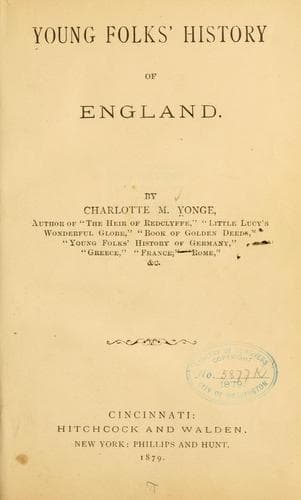
Young Folks' History of EnglandYonge, Charlotte M. (Charlotte Mary)
History
Young Folks' History of England
Yonge, Charlotte M. (Charlotte Mary)
Great Britain -- History -- Juvenile literature
George IV. was not much under sixty years old when he came to the
throne, and had really been king in all but the name for eight years
past. He had been married to the Princess Caroline of Brunswick, much
against his will, for she was, though a princess, far from being a
lady in any of her ways, and he disliked her from the first moment he
saw her; and though he could not quite treat her as Henry VIII. had
treated Anne of Cleves, the two were so unhappy together that, after
the first year, they never lived in the same house. They had had one
child, a daughter, named Charlotte--a good, bright, sensible high-
spirited girl--on whom all the hopes of the country were fixed; but
as she grew up, there were many troubles between her love and her
duty towards her father and mother. As soon as the peace was made,
the Princess of Wales went to Italy and lived there, with a great
many people of bad characters about her. Princess Charlotte was
married to Prince Leopold of Saxe-Coburg, and was very happy with
him; but, to the great grief of all England, she died in the bloom
of her youth, the year before her grandfather.
George IV., though he was much alone in the world, prepared to have a
most splendid coronation; but as soon as his wife heard that he was
king, she set off to come to England and be crowned with him. He was
exceedingly angry, forbade her name to be put into the Prayer-book as
queen, and called on the House of Lords to break his marriage with one
who had proved herself not worthy to be a wife. There was a great
uproar about it, for though the king's friends wanted him to be rid
of her, all the country knew that he had been no better to her than
she had been to him, and felt it unfair that the weaker one should
have all the shame and disgrace, and the stronger one none. One of
Caroline's defenders said that if her name were left out of the
Litany, yet still she was prayed for there as one who was desolate
and oppressed. People took up her cause much more hotly than deserved,
and the king was obliged to give up the enquiry into her behavior, but
still he would not let her be crowned. In the midst of all the
splendor and solemnity in Westminster Abbey, a carriage was driven to
the door and entrance was demanded for the queen; but she was kept
back, and the people did not seem disposed to interrupt the show by
doing anything in her favor, as she and her friends had expected.
She went back to her rooms, and, after being more foolish than ever
in her ways, died of fretting and pining. It is a sad history, where
both were much to blame; and it shows how hateful to the king she must
have been, that, when Napoleon died he was told his greatest enemy was
dead, and he answered, "When did _she_ die?" But if he had been a
good man himself, and not selfish, he would have borne with the poor,
ill brought up, giddy girl, when first she came, and that would have
prevented her going so far astray.
Public-domain text, read in full here on John Shaqi.
Reviews
Reviews
No reviews yet
Be the first to share your thoughts on this work.
Elsewhere in the archive
Join the Discussion
Join the discussion
Sign in to leave a comment or review.
Sign InorCreate an account