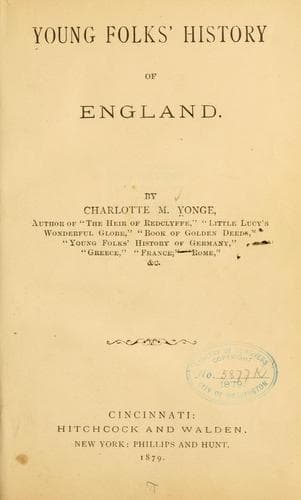
Young Folks' History of EnglandYonge, Charlotte M. (Charlotte Mary)
History
Young Folks' History of England
Yonge, Charlotte M. (Charlotte Mary)
Great Britain -- History -- Juvenile literature
George IV. made two journeys--one to Scotland, and the other to
Ireland. He was the first of the House of Brunswick who ever visited
these other two kingdoms, and he was received in both with great
splendor and rejoicing; but after this his health began to fail, and
he disliked showing himself. He spent most of his time at a house he
had built for himself at Brighton, called the Pavilion, and at Windsor,
where he used to drive about in the park. He was kind and gracious to
those with whom he associated, but they were as few as possible.
He was vexed and angry at having to consent to the Bill for letting
Roman Catholics sit in Parliament, and hold other office--the same
that his father had stood out against. It was not that he cared for
one religion more than another, for he had never been a religious
man, but he saw that it would be the beginning of a great many changes
that would alter the whole state of things. His next brother,
Frederick, Duke of York, died before him; and the third, William,
Duke of Clarence, who had been brought up as an officer in the navy,
was a friend of the Whigs, and of those who were ready to make
alterations.
Changes were coming of themselves, though--for inventions were making
progress in this time of peace. People had begun to find out the great
power of steam, and had made it move the ships, which had hitherto
depended upon the winds, and thus it became much easier to travel from
one country to another and to send goods. Steam was also being used
to work engines for spinning and weaving cotton, linen, and wool, and
for working metals; so that what had hitherto been done by hand, by
small numbers of skilful people, was now brought about by large
machines, where the labor was done by steam; but quantities of people
were needed to assist the engine. And as steam cannot be had without
fire, and most of the coal is in the Northern parts of England, almost
all of these works were set up in them, and people flocked to get work
there, so that the towns began to grow very large. Manchester was one,
with Liverpool as the sea-port from which to send its calico and get
its cotton. Sheffield and Birmingham grew famous for works in iron
and steel, and so on; and all this tended to make the manufacturers as
rich and great as the old lords and squires, who had held most of the
power in England ever since, at the Revolution, they had got it away
from the king. Everyone saw that some great change would soon come;
but before it came to the point George IV. fell ill, and died after a
reign of twenty years in reality, but of only ten in name, the first
five of which were spent in war, and the last fifteen in peace. The
Duke of Wellington and Sir Robert Peel were his chief ministers--for
the duke was as clear-headed in peace as he was in war.
CHAPTER XLVII.
WILLIAM IV. A.D. 1830--1837.
Public-domain text, read in full here on John Shaqi.
Reviews
Reviews
No reviews yet
Be the first to share your thoughts on this work.
Elsewhere in the archive
Join the Discussion
Join the discussion
Sign in to leave a comment or review.
Sign InorCreate an account