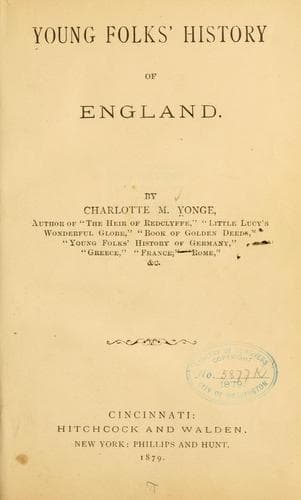
Young Folks' History of EnglandYonge, Charlotte M. (Charlotte Mary)
History
Young Folks' History of England
Yonge, Charlotte M. (Charlotte Mary)
Great Britain -- History -- Juvenile literature
Several more changes were made under King William. Most of the great
union workhouses were built then, and it was made less easy to get help
from the parish without going to live in one. This was meant to cure
people of being idle and liking to live on other folk's money--and it
has done good in that way; but workhouses are sad places for the poor
aged people who cannot work, and it is a great kindness to help them
to keep out of them.
The best thing that was done was the setting the slaves free. Look at
the map of America, and you will see a number of islands--beautiful
places, where sugar-canes, and coffee, and spices grow. Many of these
belong to the English, but it is too hot for Englishmen to work there.
So, for more than a hundred years, there had been a wicked custom that
ships should go to Africa, and there the crews would steal negro men,
women and children, or buy them of tribes of fierce negroes who had
made them captive, and carry them off to the West Indies Islands,
where they were sold to work for their masters, just as cattle are
bought and sold. An English gentleman--William Wilberforce--worked
half his life to get this horrible slave trade forbidden; and at last
he succeeded, in the year 1807, whilst George III. was still reigning.
But though no more blacks were brought from Africa, still the people
in the West Indies were allowed to keep, and buy and sell the slaves
they already had. So Wilberforce and his friends still worked on
until the time of William IV., when, in 1834, all the slaves in the
British dominions were set free.
This reign only lasted seven years, and there were no wars in it; so
the only other thing that I have to tell you about it is, that people
had gone on from finding that steam could be made to work their ships
to making it draw carriages. Railways were being made for trains of
carriages and vans to be drawn by one steam engine. The oldest of all
was opened in 1830, the very year that William IV. began to reign, and
that answered so well that more and more began to be made, and the
whole country to be covered with a network of railways, so the people
and goods could be carried about much quicker than ever was dreamt of
in old times; while steam-ships were made larger and larger, and to go
greater distances.
Besides this, many people in England found there was not work or food
enough for them at home, and went to settle in Canada, and Australia,
and Van Dieman's Land, and New Zealand, making, in all these distant
places, the new English homes called colonies; and thus there have
come to be English people wherever the sun shines.
William IV. died in the year 1837. He was the last English king who
had the German State of Hanover. It cannot belong to a woman, so it
went to his brother Ernest, instead of his niece Victoria.
CHAPTER XLVIII.
VICTORIA. A.D. 1837--1855.
The Princess Victoria, daughter of the Duke of Kent, was but eighteen
years old when she was Queen of England.
Public-domain text, read in full here on John Shaqi.
Reviews
Reviews
No reviews yet
Be the first to share your thoughts on this work.
Elsewhere in the archive
Join the Discussion
Join the discussion
Sign in to leave a comment or review.
Sign InorCreate an account