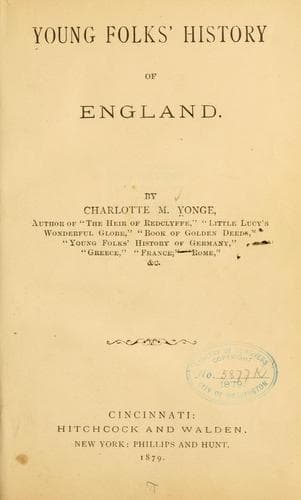
Young Folks' History of EnglandYonge, Charlotte M. (Charlotte Mary)
History
Young Folks' History of England
Yonge, Charlotte M. (Charlotte Mary)
Great Britain -- History -- Juvenile literature
George IV. had, as you know, no child living at the time of his death.
His next brother, Frederick Duke of York, died before him, likewise
without children, so the crown went to William, Duke of Clarence,
third son of George III. He had been a sailor in his younger days,
but was an elderly man when he came to the throne. He was a dull and
not a very wise man, but good-natured and kind, and had an open,
friendly, sailor manner; and his wife, Queen Adelaide, of Saxe-
Meiningen, was an excellent woman, whom everyone respected. They
never had any children but two daughters who died in infancy: and
everyone knew that the next heir must be the Princess Victoria,
daughter to the next brother, Edward, Duke of Kent, who had died the
year after she was born.
King William IV. had always been friendly with the Whigs, who wanted
power for the people. Those who went furthest among them were called
Radicals, because they wanted a radical reform--that is, going to the
root. In fact, it was time to alter the way of sending members to the
House of Commons, for some of the towns that had once been big enough
to choose one were now deserted and grown very small, while on the
other hand, others which used to be little villages, like Birmingham
and Brighton, had now become very large, and full of people.
The Duke of Wellington and his friends wanted to consider the best way
of setting these things to rights, but the Radicals wanted to do much
more and much faster than he was willing to grant. The poor fancied
that the new rights proposed would make them better off all at once,
and that every man would get a fat pig in his sty and as much bread
as he wanted; and they were so angry at any delay, that they went about
in bands burning the hay-ricks and stacks of corn, to frighten their
landlords. And the Duke of Wellington's great deeds were forgotten
in the anger of the mob, who gathered round him, ready to abuse and
pelt him as he rode along; and yet, as they saw his quiet, calm way
of going on, taking no heed to them, and quite fearless, no one raised
a hand. They broke the windows of his house in London, though, and he
had iron blinds put up to protect them. He went out of office, and
the Whigs came in, and then the Act of Parliament was passed which was
called the Reform bill--because it set to rights what had gone wrong as
to which towns should have members of their own, and, besides, allowed
everyone in a borough town, who rented a house at ten pounds a year,
to vote for the member of Parliament. A borough is a town that has a
member of Parliament, and a city is one that is large enough to have a
mayor and an alderman to manage its affairs at home.
Public-domain text, read in full here on John Shaqi.
Reviews
Reviews
No reviews yet
Be the first to share your thoughts on this work.
Elsewhere in the archive
Join the Discussion
Join the discussion
Sign in to leave a comment or review.
Sign InorCreate an account