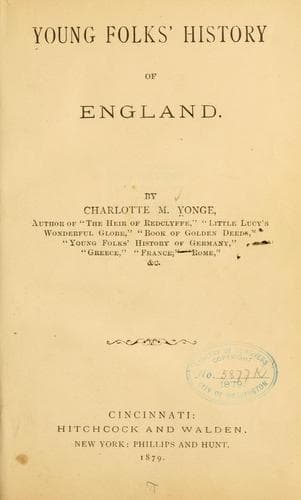
Young Folks' History of EnglandYonge, Charlotte M. (Charlotte Mary)
History
Young Folks' History of England
Yonge, Charlotte M. (Charlotte Mary)
Great Britain -- History -- Juvenile literature
William had four sons--Robert, who was called Court-hose or Short-legs;
William, called Rufus, because he had red hair; Henry, called Beau-
clerc or the fine scholar; and Richard, who was still a lad when he
was killed by a stag in the New Forest.
Robert, the eldest, was a wild, rude, thoughtless youth; but he fancied
himself fit to govern Normandy, and asked his father to give it up to
him. King William answered, "I never take my clothes off before I go
to bed," meaning that Robert must wait for his death. Robert could
not bear to be laughed at, and was very angry. Soon after, when he
was in the castle court, his two brothers, William and Henry, grew
riotous, and poured water down from the upper windows on him and his
friends. He flew into a passion, dashed up-stairs with his sword in
his hand, and might have killed his brothers if their father had not
come in to protect them. Then he threw himself on his horse and
galloped away, persuaded some friends to join him, and actually fought
a battle with his own father, in which the old king was thrown off his
horse, and hurt in the hand; but we must do the prince the justice to
say that when he recognized his father in the knight whom he had
unseated, he was filled with grief and horror, and eagerly sought his
pardon, and tenderly raised him from the ground. Then Robert wandered
about, living on money that his mother, Queen Matilda, sent him, though
his father was angry with her for doing so, and this made the first
quarrel the husband and wife had ever had.
Not long after, William went to war with the King of France. He had
caused a city to be burnt down, and was riding through the ruins, when
his horse trod on some hot ashes, and began to plunge. The king was
thrown forward on the saddle, and, being a very heavy, stout man, was
so much hurt, that, after a few weeks, in the year 1087, he died at
a little monastery, a short way from Rouen, the chief city of his
dukedom of Normandy.
He was the greatest man of his time, and he had much good in him; and
when he lay on his death-bed he grieved much for all the evil he had
brought upon the English; but that could not undo it. He had been a
great church-builder, and so were his Norman bishops and barons. You
always know their work, because it has round pillars, and round arches,
with broad borders of zig-zags, and all manner of patterns round them.
In the end, the coming of the Normans did the English much good, by
brightening them up and making them less dull and heavy; but they did
not like having a king and court who talked French, and cared more for
Normandy than for England.
CHAPTER VIII.
WILLIAM II., RUFUS. A.D. 1087-1100.
Public-domain text, read in full here on John Shaqi.
Reviews
Reviews
No reviews yet
Be the first to share your thoughts on this work.
Join the Discussion
Join the discussion
Sign in to leave a comment or review.
Sign InorCreate an account