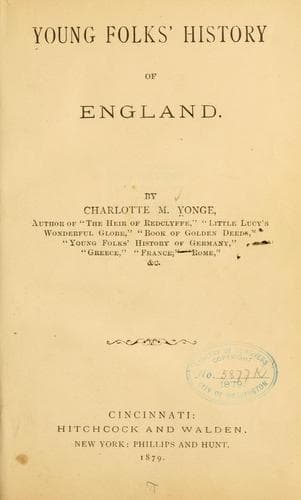
Young Folks' History of EnglandYonge, Charlotte M. (Charlotte Mary)
History
Young Folks' History of England
Yonge, Charlotte M. (Charlotte Mary)
Great Britain -- History -- Juvenile literature
Some of the Normans could not bear this any longer, and invited Henry
to come and take the dukedom. He came with an army, many of whom were
English, and fought a battle with Robert and his faithful Normans at
Trenchebray, in Normandy. They gained a great victory, and the English
thought it made up for Hastings. Poor Robert was made prisoner by his
brother, who sent him off to Cardiff Castle, in Wales, where he lived
for twenty-eight years, and then died, and was buried in Gloucester
Cathedral, with his figure made in bog oak over his monument.
Henry had two children--William and Maude. The girl was married to
the Emperor of Germany and the boy was to be the husband of Alice,
daughter to the Count of Anjou, a great French Prince, whose lands
were near Normandy. It was the custom to marry children very young
then, before they were old enough to leave their parents and make a
home for themselves. So William was taken by his father to Anjou, and
there married to the little girl, and then she was left behind, while
he was to return to England with his father. Just as he was going to
embark, a man came to the king, and begged to have the honor of taking
him across in his new vessel, called the White Ship. Henry could not
change his own plans; but, as the man begged so hard, he said his son,
the young bridegroom, and his friends might go in the White Ship.
They sailed in the evening, and there was a great merry-making on
board, till the sailors grew so drunk that they did not know how to
guide the ship, and ran her against a rock. She filled with water
and began to sink. A boat was lowered, and William safely placed in
it; but, just as he was rowed off he heard the cries of the ladies
who were left behind, and caused the oarsmen to turn back for them.
So many drowning wretches crowded into it, as soon as it came near,
that it sank with their weight, and all were lost. Only the top-mast
of the ship remained above water, and to it clung a butcher and the
owner of the ship all night long. When daylight came, and the owner
knew that the king's son was really dead, and by his fault, he lost
heart, let go the mast and was drowned. Only the butcher was taken
off alive; and for a long time no one durst tell the king what had
happened. At last a boy was sent to fall at his feet, and tell him
his son was dead. He was a broken-hearted man, and never knew
gladness again all the rest of his life.
His daughter Maude had lost her German husband, and came home. He
made her marry Geoffrey of Anjou, the brother of his son's wife, and
called upon all his chief noblemen to swear that they would take her
for their queen in England and their duchess in Normandy after his
own death.
He did not live much longer. His death was caused, in the year 1135,
by eating too much of the fish called lamprey, and he was buried in
Reading Abbey.
CHAPTER X.
STEPHEN. A.D. 1135--1154.
Public-domain text, read in full here on John Shaqi.
Reviews
Reviews
No reviews yet
Be the first to share your thoughts on this work.
Join the Discussion
Join the discussion
Sign in to leave a comment or review.
Sign InorCreate an account