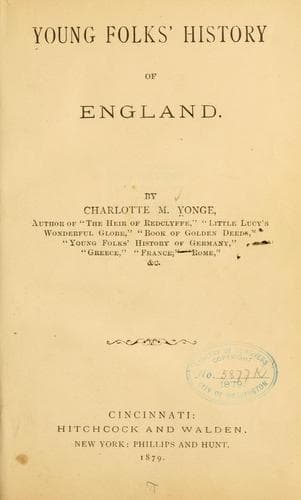
Young Folks' History of EnglandYonge, Charlotte M. (Charlotte Mary)
History
Young Folks' History of England
Yonge, Charlotte M. (Charlotte Mary)
Great Britain -- History -- Juvenile literature
Henry Fitz-Empress is counted as the first king of the Plantagenet
family, also called the House of Anjou. He was a very clever, brisk,
spirited man, who hardly ever sat down, but was always going from
place to place, and who would let no one disobey him. He kept
everybody in order, pulled down almost all the Castles that had been
built in Stephen's time, and would not let the barons ill-treat the
people. Indeed, everyone had been so mixed up together during the
wars in Stephen's reign, that the grandchildren of the Normans who
had come over with William the Conqueror were now quite English in
their feelings. French was, however, chiefly spoken at court. The
king was really a Frenchman, and he married a French wife Eleanor,
the lady of Aquitaine, a great dukedom in the South of France; and,
as Henry had already Normandy and Anjou, he really was lord of nearly
half France. He ruled England well; but he was not a good man, for
he cared for power and pleasure more than for what was right; and
sometimes he fell into such rages that he would roll on the floor,
and bite the rushes and sticks it was strewn with. He made many laws.
One was that, if a priest or monk was thought to have committed any
crime, he should be tried by the king's judge, instead of the bishop.
The Archbishop of Canterbury, Thomas a Becket, did not think it
right to consent to this law; and, though he and the king had once
been great friends, Henry was so angry with him that he was forced
to leave England, and take shelter with the King of France. Six
years passed by, and the king pretended to be reconciled to him, but
still, when they met, would not give him the kiss of peace. The
archbishop knew that this showed that the king still hated him; but
his flock had been so long without a shepherd that he thought it his
duty to go back to them. Just after his return, he laid under censure
some persons who had given offence. They went and complained to the
king, and Henry exclaimed in passion, "Will no one rid me of this
turbulent priest?" Four of his knights who heard these words set
forth to Canterbury. The archbishop guessed why they were come;
but he would not flee again, and waited for them by the altar in
the cathedral, not even letting the doors be shut. There they slew
him; and thither, in great grief at the effect of his own words, the
king came--three years later--to show his penitence by entering
barefoot, kneeling before Thomas's tomb, and causing every priest
or monk in turn to strike him with a rod. We should not exactly
call Thomas a martyr now, but he was thought so then, because he
died for upholding the privileges of the Church, and he was held
to be a very great saint.
Public-domain text, read in full here on John Shaqi.
Reviews
Reviews
No reviews yet
Be the first to share your thoughts on this work.
Join the Discussion
Join the discussion
Sign in to leave a comment or review.
Sign InorCreate an account