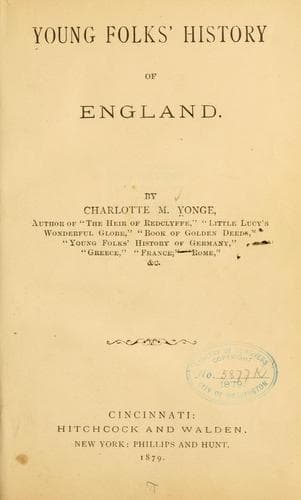
Young Folks' History of EnglandYonge, Charlotte M. (Charlotte Mary)
History
Young Folks' History of England
Yonge, Charlotte M. (Charlotte Mary)
Great Britain -- History -- Juvenile literature
There was a plan for the little Prince Edward of Caernarvon being
married to a little girl, who was grand-daughter to the King of
Scotland, and would be Queen of Scotland herself--and this would have
led to the whole island being under one king--but, unfortunately, the
little maiden died. It was so hard to decide who ought to reign, out
of all her cousins, that they asked king Edward to choose among them--
since everyone knew that a great piece of Scotland belonged to him as
over-lord, just as his own dukedom of Aquitaine belonged to the King
of France over him; and the Kings of Scotland always used to pay
homage to those of England for it.
Edward chose John Balliol, the one who had the best right; but he made
him understand that, as overlord, he meant to see that as good order
was kept in Scotland as in England. Now, the English kings had never
meddled with Scottish affairs before, and the Scots were furious at
finding that he did so. They said it was insulting them and their
king; and poor Balliol did not know what to do among them, but let
them defy Edward in his name. This brought Edward and his army to
Scotland. The strong places were taken and filled with English
soldiers, and Balliol was made prisoner, adjudged to have rebelled
against his lord and forfeited his kingdom, and was sent away to
France.
Edward thought it would be much better for the whole country to join
Scotland to England, and rule it himself. And so, no doubt, it would
have been; but many Scots were not willing,--and in spite of all the
care he could take, the soldiers who guarded his castles often behaved
shamefully to the people round them. One gentleman, named William
Wallace, whose home had been broken up by some soldiers, fled to the
woods and hills, and drew so many Scots round him that he had quite
an army. There was a great fight at the Bridge of Stirling; the
English governors were beaten, and Wallace led his men over the border
into Northumberland, where they plundered and burnt wherever they went,
in revenge for what had been done in Scotland.
Edward gathered his forces and came to Scotland. The army that Wallace
had drawn together could not stand before him, but was defeated at
Falkirk, and Wallace had to take to the woods. Edward promised pardon
to all who would submit--and almost all did; but Wallace still lurked
in the hills, till one of his own countrymen betrayed him to the
English, when he was sent to London, and put to death.
All seemed quieted, and English garrisons--that is, guarding soldiers
--were in all the Scottish towns and castles, when, suddenly, Robert
Bruce, one of the half English, half Scottish nobles between whom
Edward had judged, ran away from the English court, with his horse's
shoes put on backwards. The next thing that was heard of him was,
that he had quarreled with one of his cousins in the church at
Dumfries, and stabbed him to the heart, and then had gone to Scone
and had been crowned King of Scotland.
Public-domain text, read in full here on John Shaqi.
Reviews
Reviews
No reviews yet
Be the first to share your thoughts on this work.
Join the Discussion
Join the discussion
Sign in to leave a comment or review.
Sign InorCreate an account