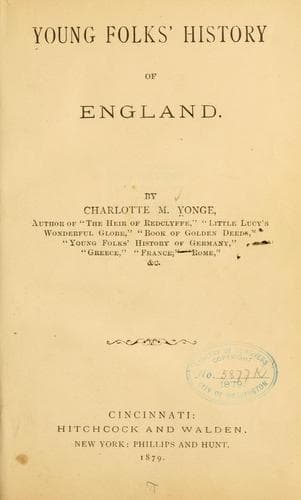
Young Folks' History of EnglandYonge, Charlotte M. (Charlotte Mary)
History
Young Folks' History of England
Yonge, Charlotte M. (Charlotte Mary)
Great Britain -- History -- Juvenile literature
Queen Isabel, Edward's mother, had, you remember, been daughter of
the King of France. All her three brothers died without leaving a
son, and their cousin, whose name was Philip, began to reign in their
stead. Edward, however, fancied that the crown of France properly
belonged to him, in right of his mother; but he did not stir about it
at once, and, perhaps, never would have done so at all, but for two
things. One was, that the King of France, Philip VI., had been so
foolish as to fancy that one of his lords, named Robert of Artois,
had been bewitching him--by sticking pins into a wax figure and
roasting it before the fire. So this Robert was driven out of France
and, coming to England, stirred Edward up to go and overthrow Philip.
The other was, that the English barons had grown so restless and
troublesome, that they would not stay peacefully at home and mind
their own estate;--but if they had not wars abroad, they always gave
the king trouble at home; and Edward liked better that they should
fight for him than against him. So he called himself King of France
and England, and began a war which lasted--with short space of quiet--
for full one hundred years, and only ended in the time of the great
grandchildren of the men who entered upon it. There was one great
sea-fight off Sluys, when the king sat in his ship, in a black velvet
dress, and gained a great victory; but it was a good while before
there was any great battle by land--so long, that the king's eldest
son, Edward Prince of Wales, was sixteen years old. He is generally
called the Black Prince--no one quite knows why, for his hair, like
that of all these old English kings, was quite light and his eyes were
blue. He was such a spirited young soldier, that when the French army
under King Philip came in sight of the English one, near the village
of Crecy, King Edward said he should have the honor of the day, and
stood under a windmill on a his watching the fight, while the prince
led the English army. He gained a very great victory, and in the
evening came and knelt before his father, saying the praise was not
his own but the king's, who had ordered all so wisely. Afterwards,
while Philip had fled away, Edward besieged Calais, the town just
opposite to Dover. The inhabitants were very brave, and held out for
a long time; and while Edward was absent, the Scots under David, the
son of Robert Bruce, came over the Border, and began to burn and
plunder in Northumberland. However, Phillipa could be brave in time
of need. She did not send for her husband, but called an army
together, and the Scots were so well beaten at Neville's Cross, that
their king, David himself, was obliged to give himself up to an
English squire. The man would not let the queen have his prisoner,
but rode day and night to Dover, and then crossed to Calais to tell
the king, who bade him put King David into Queen Philippa's keeping.
She came herself to the camp, just as the brave men of Calais had
Public-domain text, read in full here on John Shaqi.
Reviews
Reviews
No reviews yet
Be the first to share your thoughts on this work.
Join the Discussion
Join the discussion
Sign in to leave a comment or review.
Sign InorCreate an account