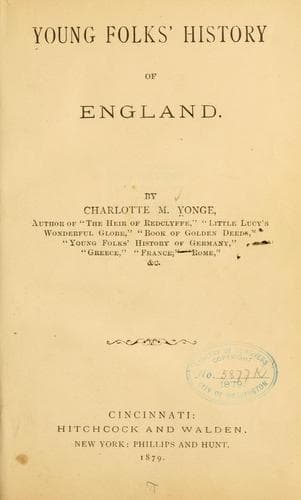
Young Folks' History of EnglandYonge, Charlotte M. (Charlotte Mary)
History
Young Folks' History of England
Yonge, Charlotte M. (Charlotte Mary)
Great Britain -- History -- Juvenile literature
The troubles were not over, however, for the Earl of Northumberland
himself, and Archbishop Scrope of York, took up arms against the
king; but they were put down without a battle. The Earl fled and
hid himself, but the archbishop was taken and beheaded--the first
bishop whom a king of England had ever put to death. The Welsh went
on plundering and doing harm, and Prince Henry had to be constantly
on the watch against them; and, in fact, there never was a reign so
full of plots and conspiracies. The king never knew whom to trust:
one friend after another turned against him, and he became soured
and wretched: he was worn out with disappointment and guarding against
everyone, and at last he grew even suspicious of his brave son Henry,
because he was so bright and bold, and was so much loved. The prince
was ordered home from Wales, and obliged to live at Windsor, with
nothing to do, while his youngest brothers were put before him and
trusted by their father--one of them even sent to command the army
in France. But happily the four brothers--Henry, Thomas, John and
Humfrey--all loved each other so well that nothing could make them
jealous or at enmity with one another. At Windsor, too, the king
kept young Edmund Mortimer--whom the Welsh had tried to make king,--
and also the young English princes, and they all led a happy life
together.
There are stories told of Henry--Prince Hal, as he was called--leading
a wild, merry life, as a sort of madcap; playing at being a robber,
and breaking into the wagons that were bringing treasure for his
father, and then giving the money back again. Also there is a story
that, when one of his friends was taken before the Lord Chief Justice,
he went and ordered him to be released and that when the justice
refused he drew his sword, upon which the justice sent him to prison;
and he went quietly, knowing it was right. The king is said to have
declared himself happy to have a judge who maintained the law so well,
and a son who would submit to it; but there does not seem to be good
reason for believing the story; and it seems clear that young Henry,
if he was full of fun and frolic, took care never to do anything
really wrong.
The king was an old man before his time. He was always ill, and often
had fits, and one of these came on when he was in Westminster Abbey.
He was taken to the room called the Jerusalem chamber, and Henry watched
him there. Another of the stories is that the king lay as if he were
dead, and the prince took the crown that was by his side and carried
it away. When the king revived, Henry brought it back, with many
excuses. "Ah, fair son," said the king, "what right have you to the
crown? you know your father had none."
"Sir," said Henry, "with your sword you took it, and with my sword I
will keep it."
"May God have mercy on my soul," said the king.
Public-domain text, read in full here on John Shaqi.
Reviews
Reviews
No reviews yet
Be the first to share your thoughts on this work.
Join the Discussion
Join the discussion
Sign in to leave a comment or review.
Sign InorCreate an account