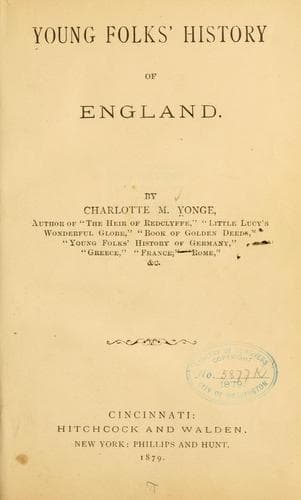
Young Folks' History of EnglandYonge, Charlotte M. (Charlotte Mary)
History
Young Folks' History of England
Yonge, Charlotte M. (Charlotte Mary)
Great Britain -- History -- Juvenile literature
The young King Henry was full of high, good thoughts. He was devout
in going to church, tried to make good Bishops, gave freely to the
poor, and was so kindly, and hearty, and merry in all his words and
ways, that everyone loved him. Still, he thought it was his duty to
go and make war in France. He had been taught to believe the kingdom
belonged to him, and it was in so wretched a state that he thought he
could do it good. The poor king, Charles VI., was mad, and had a
wicked wife besides; and his sons, and uncles, and cousins were always
fighting, till the streets of Paris were often red with blood, and the
whole country was miserable. Henry hoped to set all in order for them,
and gathering an army together, crossed to Normandy. He called on the
people to own him as their true king, and never let any harm be done
to them, for he hung any soldier who was caught stealing, or misusing
anyone. He took the town of Harfleur, on the coast of Normandy, but
not till after a long siege, when his camp was in so wet a place that
there was much illness among his men. The store of food was nearly
used up, and he was obliged to march his troops across to Calais,
which you know belonged to England, to get some more. But on the way
the French army came up to meet him--a very grand, splendid-looking
army, commanded by the king's eldest son the dauphin. Just as the
English kings' eldest son was always Prince of Wales, the French
kings' eldest son was always called Dauphin of Vienne, because Vienne,
the country that belonged to him, had a dolphin on its shield. The
French army was very large--quite twice the number of the English--
but, though Henry's men were weary and half-starved, and many
of them sick, they were not afraid, but believed their king when he
told them that there were enough Frenchmen to kill, enough to run
away, enough to make prisoners. At night, however, the English had
solemn prayers, and made themselves ready, and the king walked from
tent to tent to see that each man was in his place; while, on the
other hand, the French were feasting and revelling, and settling
what they would do the English when they had made them prisoners.
They were close to a little village which the English called Agincourt,
and, though that is not quite its right name, it is what we have
called the battle ever since. The French, owing to the quarrelsome
state of the country, had no order or obedience among them. Nobody
would obey any other; and when their own archers were in the way, the
horsemen began cutting them down as if they were the enemy. Some
fought bravely, but it was of little use; and by night all the French
were routed, and King Henry's banner waving in victory over the field.
He went back to England in great glory, and all the aldermen of London
came out to meet him in red gowns and gold chains, and among them was
Sir Richard Whittington, the great silk mercer.
Public-domain text, read in full here on John Shaqi.
Reviews
Reviews
No reviews yet
Be the first to share your thoughts on this work.
Join the Discussion
Join the discussion
Sign in to leave a comment or review.
Sign InorCreate an account