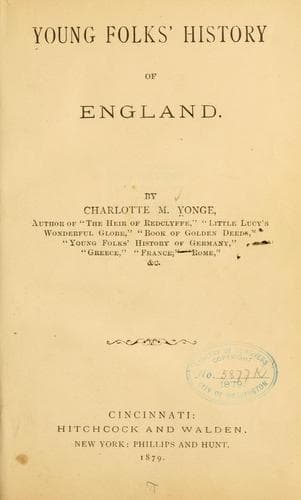
Young Folks' History of EnglandYonge, Charlotte M. (Charlotte Mary)
History
Young Folks' History of England
Yonge, Charlotte M. (Charlotte Mary)
Great Britain -- History -- Juvenile literature
But the spirit she had stirred up never died away. The French went on
winning back more and more; and there were so many quarrels among the
English that they had little chance of keeping anything. The king's
youngest uncle, Humfrey, Duke of Gloucester, was always disputing with
the Beaufort family. John of Gaunt, Duke of Lancaster--father to Henry
IV.--had, late in life, married a person of low birth, and her children
were called Beaufort, after the castle where they were born--not
Plantagenet--and were hardly reckoned as princes by other people; but
they were very proud, and thought themselves equal to anybody. The
good Duke of Bedford died quite worn out with trying to keep the peace
among them, and to get proper help from England to save the lands his
brother had won in France. All this time, the king liked the Beauforts
much better than Duke Humfrey, and he followed their advice, and that
of their friend, the Earl of Suffolk, in marrying Margaret of Anjou--
the daughter of a French prince, who had a right to a great part of
the lands the English held. All these were given back to her father,
and this made the Duke of Gloucester and all the English more angry,
and they hated the young queen as the cause. She was as bold and
high-spirited as the king was gentle and meek. He loved nothing so
well as praying, praising God, and reading; and he did one great thing
for the country--which did more for it than all the fighting kings had
done--he founded Eton College, close to Windsor Castle; and there many
of our best clergymen, and soldiers, and statesmen, have had their
education. But while he was happy over rules for his scholars, and
in plans for the beautiful chapel, the queen was eagerly taking part
in the quarrels, and the nation hated her the more for interfering.
And very strangely, Humfrey, Duke of Gloucester, was, at the meeting
of Parliament, accused of high treason and sent to prison, where, in
a few days, he was found dead in his bed--just like his great-uncle,
Thomas, Duke of Gloucester; nor does anyone understand the mystery
in one case, better than in the other, except that we are more sure
that gentle Henry VI. had nothing to do with it than we can be of
Richard II.
These were very bad times. There was a rising like Wat Tyler's, under
a man named Jack Cade, who held London for two or three days before he
was put down; and, almost at the same time, the queen's first English
friend, Suffolk, was exiled by her enemies, and taken at sea and
murdered by some sailors. Moreover, the last of the brave old friends
of Henry V. was killed in France, while trying to save the remains of
the old duchy of Aquitaine, which had belonged to the English kings
ever since Henry II. married Queen Eleanor. That was the end of the
hundred years' war, for peace was made at last, and England kept
nothing in France but the one city of Calais.
Public-domain text, read in full here on John Shaqi.
Reviews
Reviews
No reviews yet
Be the first to share your thoughts on this work.
Join the Discussion
Join the discussion
Sign in to leave a comment or review.
Sign InorCreate an account