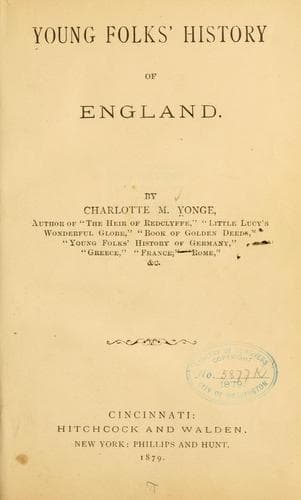
Young Folks' History of EnglandYonge, Charlotte M. (Charlotte Mary)
History
Young Folks' History of England
Yonge, Charlotte M. (Charlotte Mary)
Great Britain -- History -- Juvenile literature
There were many people, however, who were glad to break with the pope,
because so much had gone amiss in the Church, and they wanted to set
it to rights. There was so much more reading, now that printing had
been invented, that many could read who had never learnt Latin, and
so a translation of the Bible was to be made for them, and there was
a great desire that the Church Services--many of which had also been
in Latin--should likewise be put into English, and the litany was first
translated, but no more at present. The king and Crumwell had taken
it upon them to go on with what had been begun in Wolsey's time--the
looking into the state of all the monasteries. Some were found going
on badly, and the messengers took care to make the worst of everything.
So all the worst houses were broken up, and the monks sent to their
homes, with a small payment to maintain them for the rest of their
lives.
As to the lands that good men of old had given to keep up the convents,
that God might be praised there, Henry made gifts of them to the lords
about Court. Whoever chose to ask for an abbey could get it, from the
king's good nature; and, as they wanted more and more, Henry went on
breaking up the monasteries, till the whole of them were gone. A good
deal of their riches he kept for himself, and two new bishoprics were
endowed from their spoils, but most of them were bestowed on the
courtiers. The king, however, did not at all intend to change the
teaching of the Church, and whenever a person was detected in teaching
any thing contrary to her doctrines, as they were at the time
understood, he was tried by a court of clergymen and lawyers before
the bishop, and, if convicted, was--according to the cruel custom of
those times--burnt to death at a stake in the market place of the
next town.
Meantime, the new queen, Anne Boleyn, whom the king had married
privately in May, 1533, had not prospered. She had one little
daughter, named Elizabeth, and a son, who died; and then the king
began to admire one of her ladies, named Jane Seymour. Seeing this
Anne's enemies either invented stories against her, or made the worst
of some foolish, unlady-like, and unqueen-like things she had said
and done, so that the king thought she wished for his death. She was
accused of high treason, sentenced to death, and beheaded: thus
paying a heavy price for the harm she had done good Queen Katharine.
The king, directly after, married Jane Seymour; but she lived only a
very short time, dying immediately after the christening of her first
son, who was named Edward.
Public-domain text, read in full here on John Shaqi.
Reviews
Reviews
No reviews yet
Be the first to share your thoughts on this work.
Elsewhere in the archive
Join the Discussion
Join the discussion
Sign in to leave a comment or review.
Sign InorCreate an account