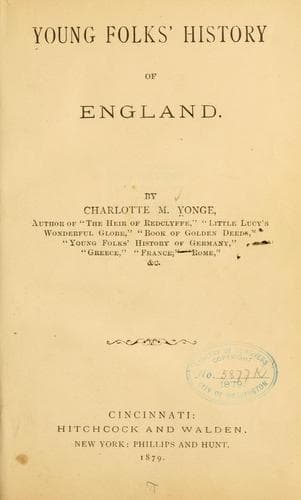
Young Folks' History of EnglandYonge, Charlotte M. (Charlotte Mary)
History
Young Folks' History of England
Yonge, Charlotte M. (Charlotte Mary)
Great Britain -- History -- Juvenile literature
Some English children were made slaves, and carried to Rome, where
they were set in the market-place to be sold. A good priest, named
Gregory, was walking by. He saw their fair faces, blue eyes, and long
light hair, and, stopping, he asked who they were. "Angles," he was
told, "from the isle of Britain." "Angles?" he said, "they have angel
faces, and they ought to be heirs with the angels in heaven." From
that time this good man tried to find means to send teachers to teach
the English the Christian faith. He had to wait for many years, and,
in that time, he was made Pope, namely, Father-Bishop of Rome. At
last he heard that one of the chief English kings, Ethelbert of Kent,
had married Bertha, the daughter of the King of Paris, who was a
Christian, and that she was to be allowed to bring a priest with her,
and have a church to worship in.
Gregory thought this would make a beginning: so he sent a priest,
whose name was Augustine, with a letter to King Ethelbert and Queen
Bertha, and asked the King to listen to him. Ethelbert met Augustine
in the open air, under a tree at Canterbury, and heard him tell about
the true God, and JESUS CHRIST, whom He sent; and, after some time,
and a great deal of teaching, Ethelbert gave up worshiping Woden and
Thor, and believed in the true God, and was baptized, and many of his
people with him. Then Augustine was made Archbishop of Canterbury;
and, one after another, in the course of the next hundred years, all
the English kingdoms learnt to know God, and broke down their idols,
and became Christian.
Bishops were appointed, and churches were built, and parishes were
marked off--a great many of them the very same that we have now. Here
and there, when men and women wanted to be very good indeed, and to
give their whole lives to doing nothing but serving God, without any
of the fighting and feasting, the buying and selling of the outer
world, they built houses, where they might live apart, and churches,
where there might be services seven times a day. These houses were
named abbeys. Those for men were, sometimes, also called monasteries,
and the men in them were termed monks, while the women were called
nuns, and their homes convents of nunneries. They had plain dark
dresses, and hoods, and the women always had veils. The monks used
to promise that they would work as well as pray, so they used to build
their abbeys by some forest or marsh, and bring it all into order,
turning the wild place into fields, full of wheat. Others used to
copy out the Holy Scriptures and other good books upon parchment--
because there was no paper in those days, nor any printing--drawing
beautiful painted pictures at the beginning of the chapters, which
were called illuminations. The nun did needlework and embroidery,
as hangings for the altar, and garments for the priests, all bright
with beautiful colors, and stiff with gold. The English nuns' work
was the most beautiful to be seen anywhere.
Public-domain text, read in full here on John Shaqi.
Reviews
Reviews
No reviews yet
Be the first to share your thoughts on this work.
Join the Discussion
Join the discussion
Sign in to leave a comment or review.
Sign InorCreate an account