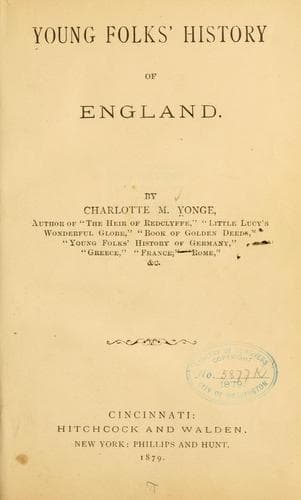
Young Folks' History of EnglandYonge, Charlotte M. (Charlotte Mary)
History
Young Folks' History of England
Yonge, Charlotte M. (Charlotte Mary)
Great Britain -- History -- Juvenile literature
Then the king was persuaded by Lord Crumwell to marry a foreign
princess called Anne of Cleves. A great painter was sent to bring her
picture, and made her very beautiful in it; but when she arrived, she
proved to be not only plain-featured but large and clumsy, and the
king could not bear the sight of her, and said they had sent him a
great Flanders mare by way of queen. So he made Cranmer find some
foolish excuse for breaking this marriage also, and was so angry with
Thomas Crumwell for having led him into it, that this favorite was in
turn thrown into prison and beheaded.
The king chose another English wife, named Katharine Howard; but,
after he had married her, it was found out that she had been very ill
brought up, and the bad people with whom she had been left came and
accused her of the evil into which they had led her. So the king cut
off her head, likewise, and then wanted to find another wife; but no
foreign princess would take a husband who had put away two wives and
beheaded two more, and one Italian lady actually answered that she
was much obliged to him, but she could not venture to marry him,
because she had only one neck.
At last he found an English widow, Lady Latimer, whose maiden name
was Katharine Parr, and married her. He was diseased now, lame with
gout, and very large and fat; and she nursed him kindly, and being a
good-natured woman, persuaded him to be kinder to his daughters, Mary
and Elizabeth, than he had ever been since the disgrace of their
mothers; and she did her best to keep him in good humor, but he went
on doing cruel things, even to the end of his life; and, at the very
last, had in prison the very same Duke of Norfolk who had won the
battle of Flodden, and would have put him to death in a few days'
time, only that his own death prevented it.
Yet, strange to say, Henry VIII. was not hated as might have been
expected. His cruelties were chiefly to the nobles, not to the common
people; and he would do good-natured things, and speak with a frank,
open manner, that was much liked. England was prosperous, too, and
shopkeepers, farmers, and all were well off; there was plenty of
bread and meat for all, and the foreign nations were afraid to go
to war with us. So the English people, on the whole, loved "Bluff
King Hal," as they called him, and did not think much about his many
wickednesses, or care how many heads he cut off. He died in the year
1547. The changes in his time are generally called the beginning of
the Reformation.
CHAPTER XXVIII.
EDWARD VI. A.D. 1547--1553.
The little son of Henry VIII. and Jane Seymour of course reigned
after him as Edward VI. He was a quiet, gentle boy exceedingly fond
of learning and study, and there were great expectations of him; but, as
he was only nine years old, the affairs of state were managed by his
council.
Public-domain text, read in full here on John Shaqi.
Reviews
Reviews
No reviews yet
Be the first to share your thoughts on this work.
Elsewhere in the archive
Join the Discussion
Join the discussion
Sign in to leave a comment or review.
Sign InorCreate an account