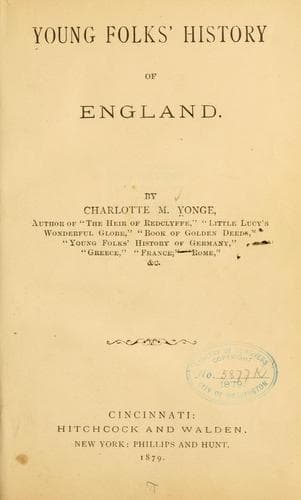
Young Folks' History of EnglandYonge, Charlotte M. (Charlotte Mary)
History
Young Folks' History of England
Yonge, Charlotte M. (Charlotte Mary)
Great Britain -- History -- Juvenile literature
punished the clerks who sent it off, as if it had been their fault.
So Queen Mary of Scotland was beheaded at Fotheringay Castle, showing
much bravery and piety. There are many people who still believe that
she was really innocent of all that she was accused of, and that she
only was ruined by the plots that were laid against her.
CHAPTER XXXI.
ELIZABETH'S REIGN. A.D. 1587--1602.
No reign ever was more glorious or better for the people than Queen
Elizabeth's. It was a time when there were many very great men living
--soldiers, sailors, writers, poets--and they all loved and look up to
the queen as the mother of her country. There really was nothing she
did love like the good of her people, and somehow they all felt and
knew it, and "Good Queen Bess" had their hearts--though she was not
always right, and had some serious faults.
The worst of her faults was not telling the truth. Somehow kings and
rulers had, at that time, learnt to believe that when they were dealing
with other countries anything was fair, and that it was not wrong to
tell falsehoods to hide a secret, nor to make promises they never meant
to keep. People used to do so who would never have told a lie on their
own account to their neighbor, and Lord Burleigh and Queen Elizabeth
did so very often, and often behaved meanly and shabbily to people who
had trusted to their promises. Her other fault was vanity. She was
a little woman, with bright eyes, and rather hooked nose, and sandy
hair, but she managed to look every inch a queen, and her eye, when
displeased, was like a lion's. She had really been in love with Lord
Leicester, and every now and then he hoped she would marry him; indeed,
there is reason to fear that he had his wife secretly killed, in order
that he might be able to wed the queen; but she saw that the people
would not allow her to do so, and gave it up. But she liked to be
courted. She allowed foreign princes to send her their portraits,
rings, and jewels, and sometimes to come and see her, but she never
made up her mind to take them. And as to the gentlemen at her own
court, she liked them to make the most absurd and ridiculous
compliments to her, calling her their sun and goddess, and her hair
golden beams of the morning, and the like; and the older she grew the
more of these fine speeches she required of them. Her dress--a huge
hoop, a tall ruff all over lace, and jewels in the utmost profusion--
was as splendid as it could be made, and in wonderful variety. She is
said to have had three hundred gowns and thirty wigs. Lord Burleigh
said of her that she was sometimes more than a man, and sometimes less
than a woman. And so she was, when she did not like her ladies to
wear handsome dresses.
Public-domain text, read in full here on John Shaqi.
Reviews
Reviews
No reviews yet
Be the first to share your thoughts on this work.
Elsewhere in the archive
Join the Discussion
Join the discussion
Sign in to leave a comment or review.
Sign InorCreate an account