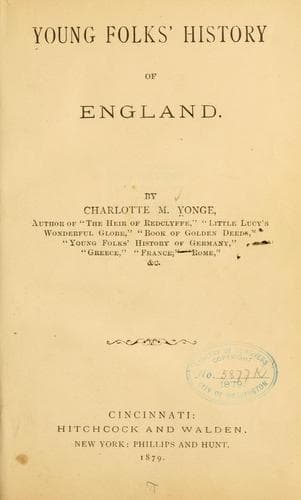
Young Folks' History of EnglandYonge, Charlotte M. (Charlotte Mary)
History
Young Folks' History of England
Yonge, Charlotte M. (Charlotte Mary)
Great Britain -- History -- Juvenile literature
The queen valued these brave men much, but she liked none so well as
Lord Essex, till at last he displeased her, and she sent him to govern
Ireland. There he fell into difficulties, and she wrote angry letters,
which made him think his enemies were setting her against him. So he
came back without leave; and one morning came straight into her
dressing chamber, where she was sitting, with her thin grey hair being
combed, before she put on one of her thirty wigs, or painted her face.
She was very angry, and would not forgive him, and he got into a rage,
too; and she heard he had said she was an old woman, crooked in temper
as in person. What was far worse, he raised the Londoners to break
out in a tumult to uphold him. He was taken and sent to the Tower,
tried for treason, and found guilty of death. But the queen still
loved him, and waited and waited for some message or token to ask her
pardon. None came, and she thought he was too proud to beg for mercy.
She signed the death warrant, and Essex died on the block. But soon
she found that he had really sent a ring she once had given him, to a
lady who was to show it to her, in token that he craved her pardon.
The ring had been taken by mistake to a cruel lady who hated him, and
kept it back. But by-and-by this lady was sick to death. Then she
repented, and sent for the queen and gave her the ring, and confessed
her wickedness. Poor Queen Elizabeth--her very heart was broken. She
said to the dying woman, "God may forgive you, but I cannot." She
said little more after that. She was old, and her strength failed
her. Day after day she sat on a pile of cushions, with her finger
on her lips, still growing weaker, and begging for the prayers the
archbishop read her. And thus, she who had once been so great and
spirited, sank into death, when seventy years old, in the year 1602.
CHAPTER XXXII.
JAMES I. A.D. 1602--1625.
After Queen Elizabeth's death, the next heir was James, the son of
Mary of Scotland, and had reigned there ever since his mother had been
driven away. He had been brought up very strictly by the Scottish
Reformers, who had made him very learned, and kept him under great
restraint; and all that he had undergone had tended to make him
awkward and strange in his manners. He was timid, and could not bear
to see a drawn sword; and he was so much afraid of being murdered,
that he used to wear a dress padded and stuffed out all over with
wool, which made him look even more clumsy than he was by nature.
Public-domain text, read in full here on John Shaqi.
Reviews
Reviews
No reviews yet
Be the first to share your thoughts on this work.
Elsewhere in the archive
Join the Discussion
Join the discussion
Sign in to leave a comment or review.
Sign InorCreate an account