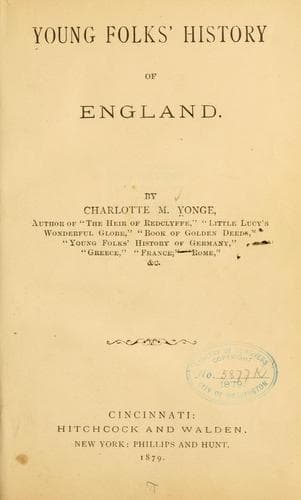
Young Folks' History of EnglandYonge, Charlotte M. (Charlotte Mary)
History
Young Folks' History of England
Yonge, Charlotte M. (Charlotte Mary)
Great Britain -- History -- Juvenile literature
When Charles I. was obliged to call his Parliament, the House of
Commons met, angered at the length of time that had passed since
they had been called, and determined to use their opportunity. They
speedily put an end both to the payment of ship money and to the Court
of the Star Chamber; and they threw into prison the two among the
king's friends whom they most disliked, namely, Archbishop Laud and
the Earl of Strafford. The earl had been governor of Ireland, and
had kept great order there, but severely; and he thought that the
king was the only person who ought to have any power, and was always
advising the king to put down all resistance by the strong hand.
He was thought a hard man, and very much hated; and when he was tried
the Houses of Parliament gave sentence against him that he should be
beheaded. Still, this could not be done without the king's warrant;
and Charles at first stood out against giving up his faithful friend.
But there was a great tumult, and the queen and her mother grew
frightened, and entreated the king to save himself by giving up Lord
Strafford, until at last he consented, and signed the paper ordering
the execution. It was a sad act of weakness and cowardice, and he
mourned over it all the days of his life.
The Parliament only asked more and more, and at last the king thought
he must put a check on them. So he resolved to go down to the House
and cause the five members who spoke against his power to be taken
prisoners in his own presence. But he told his wife what he intended,
and Henrietta Maria was so foolish as to tell Lady Carlisle, one of
her ladies, and she sent warning to the five gentlemen, so that they
were not in the House when Charles arrived; and the Londoners rose up
in a great mob, and showed themselves so angry with him, that he took
the queen and his children away into the country. The queen took her
daughter Mary to Holland to marry the Prince of Orange; and there she
bought muskets and gunpowder for her husband's army--for things had
come to pass now that a civil war began. A civil war is the worst
of all wars, for it is one between the people of the same country.
England had had two civil wars before. There were the Barons' wars,
between Henry III. and Simon de Montfort, about the keeping of Magna
Carta; and there were the wars of the Roses, to settle whether York
or Lancaster should reign. This war between Charles I. and the
Parliament was to decide whether the king or the House of Commons
should be most powerful. Those who held with the king called
themselves Cavaliers, but the friends of the Parliament called them
Malignants; and they in turn nicknamed the Parliamentary party
Roundheads, because they often chose not to wear their hair in the
prevailing fashion, long and flowing on their shoulders, but cut
short round their heads. Most of the Roundheads were Puritans, and
hated the Prayer-book, and all the strict rules for religious worship
Public-domain text, read in full here on John Shaqi.
Reviews
Reviews
No reviews yet
Be the first to share your thoughts on this work.
Elsewhere in the archive
Join the Discussion
Join the discussion
Sign in to leave a comment or review.
Sign InorCreate an account