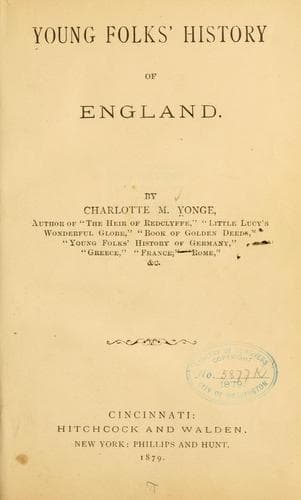
Young Folks' History of EnglandYonge, Charlotte M. (Charlotte Mary)
History
Young Folks' History of England
Yonge, Charlotte M. (Charlotte Mary)
Great Britain -- History -- Juvenile literature
that Archbishop Laud had brought in; and the Cavaliers, on the other
hand, held by the bishops and the Prayer-book. Some of the Cavaliers
were very good men indeed, and led holy and Christian lives, like
their master the king, but there were others who were only bold,
dashing men, careless and full of mirth and mischief; and the
Puritans were apt to think all amusements and pleasures wrong,
so that they made out the Cavaliers worse than they really were.
I do not think you would understand about all the battles, so I shall
only tell you now that the king's army was chiefly led by his nephew,
Prince Rupert, the son of his sister Elizabeth. Rupert was a fiery,
brave young man, who was apt to think a battle was won before it
really was, and would ride after the people he had beaten himself
without waiting to see whether his help was wanted by the other
captains; and so he did his uncle's cause as much harm as good.
The king's party had been the most used to war, and they prospered
the most at first; but as the soldiers of the Parliament became more
trained, they gained the advantage. One of the members of Parliament,
a gentleman named Oliver Cromwell, soon showed himself to be a much
better captain than any one else in England, and from the time he came
to the chief command the Parliament always had the victory. The places
of the three chief battles were Edgehill, Marston Moor, and Naseby.
The first was doubtful, but the other two were great victories of the
Roundheads. Just after Marston Moor, the Parliament put to death
Archbishop Laud; and, at the same time, they forbade the use of the
Prayer-book, and turned out all the parish priests from the churches,
putting in their stead men chosen after their own fashion, and not
ordained by bishops. They likewise destroyed all they disliked in the
churches--the painted glass, the organs, and the carvings; and when
the Puritan soldiers took possession of a town or village, they would
stable their horses in the churches, use the font for a trough, and
shoot at the windows as marks.
After the battle of Naseby, King Charles was in such distress that he
thought he would go to the Scots, remembering that, though he had
offended them by trying to make them use the Prayer-book, he had been
born among them, and he thought they would prefer him to the English.
But when he came, the Scottish army treated him like a prisoner, and
showed him very few honors; and at last they gave him up to the
English Parliament for a great sum of money.
So Charles was a prisoner to his own subjects. This Parliament is
called the Long Parliament, because it sat longer than any other
Parliament ever did: indeed it had passed a resolution that it could
not be dissolved.
CHAPTER XXXV.
DEATH OF CHARLES I. A.D. 1649--1651.
Public-domain text, read in full here on John Shaqi.
Reviews
Reviews
No reviews yet
Be the first to share your thoughts on this work.
Elsewhere in the archive
Join the Discussion
Join the discussion
Sign in to leave a comment or review.
Sign InorCreate an account