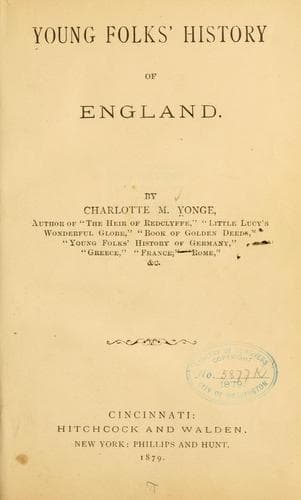
Young Folks' History of EnglandYonge, Charlotte M. (Charlotte Mary)
History
Young Folks' History of England
Yonge, Charlotte M. (Charlotte Mary)
Great Britain -- History -- Juvenile literature
The Long Parliament did not wish to have no king, only to make him do
what they pleased; and then went on trying whether he would come back
to reign according to their notions. He would have given up a great
deal, but when they wanted him to declare that there should be no
bishops in England he would never consent, for he thought there could
be no real Church without bishops, as our Lord himself had appointed.
At last, after there had been much debating, and it was plain that it
would never come to an end, Oliver Cromwell sent some of his officers
to take King Charles into their hands, instead of the persons appointed
by Parliament. So the king was prisoner to the army instead of to the
parliament.
Cromwell was a very able man, and he saw that nobody could settle the
difficulties about the law and the rights of the people but himself.
He saw that things never would be settled while the king lived, nor
by the Parliament, so he sent one of his officers, named Pryde, to
turnout all the members of Parliament who would not do his will, and
then the fifty who were left appointed a court of officers and lawyers
to try the king. Charles was brought before them; but, as they had
no right to try him, he would not say a word in answer to them.
Nevertheless, they sentenced him to have his head cut off. He had
borne all his troubles in the most meek and patient way, forgiving
all his enemies and praying for them: and he was ready to die in the
same temper. His queen was in France, and all his children were safe
out of England, except his daughter Elizabeth, who was twelve years
old, and little Henry, who was five. They were brought to Whitehall
Palace for him to see the night before he was to die. He took the
little boy on his knee, and talked a long time to Elizabeth, telling
her what books to read and giving her his message to her mother and
brothers; and then he told little Henry to mark what he said, and to
mind that he must never be set up as a king while his elder brothers,
Charles and James were alive. The little boy said through his tears,
"I will be torn to pieces first." His father kissed and blessed the
two children, and left them.
The next day was the 30th of January, 1649. The king was allowed to
have Bishop Juxon to read and pray with him, and to give him the holy
communion. After that, forgiving his enemies and praying for them,
he was led to the Banqueting House at Whitehall, and out through a
window, on to the scaffold hung with black cloth. He said his last
prayers, and the executioner cut off his head with one blow, and held
it up to the people. He was buried at night,--a light snow falling
at the time,--in St. George's Chapel at Windsor, by four faithful
noblemen, but they were not allowed to use any service over his grave.
Public-domain text, read in full here on John Shaqi.
Reviews
Reviews
No reviews yet
Be the first to share your thoughts on this work.
Elsewhere in the archive
Join the Discussion
Join the discussion
Sign in to leave a comment or review.
Sign InorCreate an account