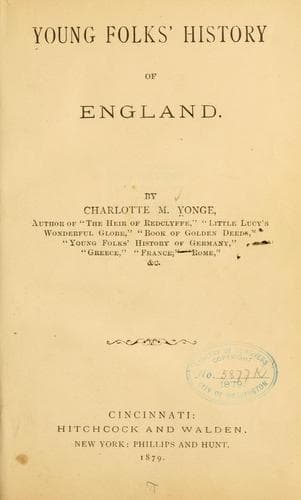
Young Folks' History of EnglandYonge, Charlotte M. (Charlotte Mary)
History
Young Folks' History of England
Yonge, Charlotte M. (Charlotte Mary)
Great Britain -- History -- Juvenile literature
Little Henrietta could not speak plain, but she always called herself
by a name she meant to be princess, and the lady was obliged to call
her Piers, and pretend that she was a little boy, when the poor child
grew angry at being treated so differently from usual, and did all she
possibly could to make the strangers understand that she was no beggar
boy. However, at last she was safe across the sea, and was with her
mother at Paris, where the king of France, Queen Henrietta's nephew,
was very kind to the poor exiles. The misfortune was, that the queen
brought up little Henrietta as a Roman Catholic, and tried to make
Henry one also; but he was old enough to be firm to his father's
Church, and he went away to his sister in Holland. James, however
did somewhat late become a Roman Catholic; and Charles would have
been one, if he had cared enough about religion to do what would have
lessened his chance of getting back to England as king. But these two
brothers were learning no good at Paris, and were growing careless of
the right and fond of pleasure. James and Henry, after a time, joined
the French army, that they might learn the art of war. They were both
very brave, but it was sad that when France and England went to war,
they should be in the army of the enemies of their country.
CHAPTER XXXVI.
OLIVER CROMWELL. A.D. 1649--1660.
Oliver Cromwell felt, as has been said, that there was no one who
could set matters to rights as he could in England. He had shewn
that the country could not do without him, if it was to go on without
the old government. Not only had he conquered and slain Charles I.,
and beaten that king's friends and those of his son in Scotland, but
he had put down a terrible rising of the Irish, and suppressed them
with much more cruelty than he generally showed.
He found that the old Long Parliament did nothing but blunder and talk,
so he marched into the House one day with a company of soldiers, and
sternly ordered the members all off, calling out, as he pointed to the
mace that lay before the Speaker's chair, "Take away that bauble."
After that he called together a fresh Parliament; but there were very
few members, and those only men who would do as he bade them. The
Speaker was a leather-seller named Barebones, so that this is generally
known as Barebones' Parliament. By these people he was named Lord
Protector of England; and as his soldiers would still do anything for
him, he reigned for five years, just as a king might have done, and a
good king too.
Public-domain text, read in full here on John Shaqi.
Reviews
Reviews
No reviews yet
Be the first to share your thoughts on this work.
Elsewhere in the archive
Join the Discussion
Join the discussion
Sign in to leave a comment or review.
Sign InorCreate an account