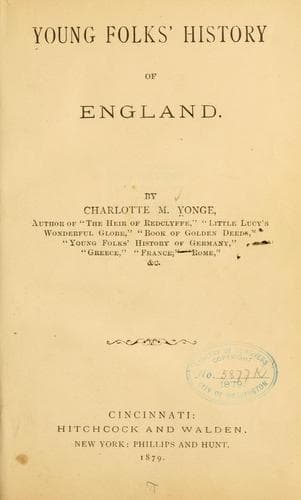
Young Folks' History of EnglandYonge, Charlotte M. (Charlotte Mary)
History
Young Folks' History of England
Yonge, Charlotte M. (Charlotte Mary)
Great Britain -- History -- Juvenile literature
He was by no means a cruel or unmerciful man, and he did not persecute
the Cavaliers more than he could help, if he was to keep up his power;
though, of course, they suffered a great deal, since they had fines
laid upon them, and some forfeited their estates for having resisted
the Parliament. Many had to live in Holland or France, because there
was no safety for them in England, and their wives went backwards and
forwards to their homes to collect their rents, and obtain something
to live upon. The bishops and clergy had all been driven out, and in
no church was it allowable to use the Prayer-book; so there used to
be secret meetings in rooms, or vaults, or in woods, where the prayers
could be used as of old, and the holy sacrament administered.
For five years Cromwell was Lord Protector, but in the year 1658 he
died, advising that his son Richard should be chosen Protector in his
stead. Richard Cromwell was a kind, amiable gentleman, but not clever
or strong like his father, and he very soon found that to govern
England was quite beyond his power; so he gave up, and went to live
at his own home again, while the English people gave him the nick-name
Tumble-down-Dick.
No one seemed well to know what was to be done next; but General Monk,
who was now at the head of the army, thought the best thing possible
would be to bring back the king. A new Parliament was elected, and
sent an invitation to Charles II. to come back again and reign like
his forefathers. He accepted it; the fleet was sent to fetch him, and
on the 29th of May, 1660, he rode into London between his brothers,
James and Henry. The streets were dressed with green boughs, the
windows hung with tapestry, and everyone shewed such intense joy and
delight, the king said he could not think why he should have
stayed away so long, since everyone was so glad to see him back again.
But the joy of his return was clouded by the deaths of his sister
Mary, the Princess of Orange, and of his brother Henry, who was only
just twenty. Mary left a son, William, Prince of Orange, of whom you
will hear more.
The bishops were restored, and, as there had been no archbishop since
Laud had been beheaded, good Juxon, who had attended King Charles at
his death, was made archbishop in his room. The persons who had been
put into the parishes to act as clergymen, were obliged to give place
to the real original parish priest; but if he were dead, as was often
the case, they were told that they might stay, if they would be
ordained by the bishops and obey the Prayer-book. Some did so, some
made an arrangement for keeping the parsonages, and paying a curate
to take the service in church; but those who were the most really in
earnest gave up everything, and were turned out--but only as they had
turned out the former clergymen ten or twelve years before.
Public-domain text, read in full here on John Shaqi.
Reviews
Reviews
No reviews yet
Be the first to share your thoughts on this work.
Elsewhere in the archive
Join the Discussion
Join the discussion
Sign in to leave a comment or review.
Sign InorCreate an account