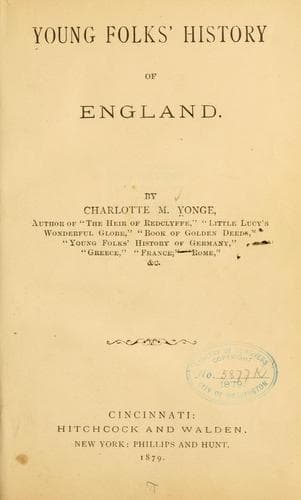
Young Folks' History of EnglandYonge, Charlotte M. (Charlotte Mary)
History
Young Folks' History of England
Yonge, Charlotte M. (Charlotte Mary)
Great Britain -- History -- Juvenile literature
The Duke of Monmouth came across from Holland, and was proclaimed king
in his uncle's stead at Exeter. Many people in the West of England
joined him, and at Taunton, in Somersetshire, he was received by rows
of little girls standing by the gate in white frocks, strewing flowers
before him. But at Sedgemoor he was met by the army, and his friends
were routed; he himself fled away, and at last was caught hiding in a
ditch, dressed in a laborer's smock frock, and with his pockets full
of peas from the fields. He was taken to London, tried, and executed.
He did not deserve much pity, but James ought not to have let the
people who favored him be cruelly treated. Sir George Jeffreys, the
chief justice, was sent to try all who had been concerned, from
Winchester to Exeter; and he hung so many, and treated all so savagely,
that his progress was called the Bloody Assize. Even the poor little
maids at Taunton were thrown into a horrible, dirty jail, and only
released on their parents paying a heavy sum of money for them.
This was a bad beginning for James's reign; and the English grew more
angry and suspicious when they saw that he favored Roman Catholics
more than anyone else, and even put them into places that only
clergymen of the Church of England could fill. Then he put forth a
decree, declaring that a person might be chosen to any office in the
State, whether he were a member of the English Church or no; and he
commanded that every clergyman should read it from his pulpit on
Sunday mornings. Archbishop Sancroft did not think it a right thing
for clergymen to read, and he and six more bishops presented a
petition to the king against being obliged to read it. One of these
was Thomas Ken, Bishop of Bath and Wells, who wrote the morning hymn,
"Awake, my soul, and with the sun," and the evening hymn, "All praise
to Thee, my God, this night." Instead of listening to their petition,
the king had all the seven bishops sent to the Tower, and tried for
libel--that is, for malicious writing. All England was full of
anxiety, and when at last the jury gave the verdict of "not guilty,"
the whole of London rang with shouts of joy, and the soldiers in their
camp shouted still louder.
This might have been a warning to the king; for he thought that, as he
paid the army, they were all on his side, and would make the people
bear whatever he pleased. The chief comfort people had was in thinking
their troubles would only last during his reign: for his first wife,
an Englishwoman, had only left him two daughters, Mary and Anne, and
Mary was married to her cousin William, Prince of Orange, who was a
great enemy of the King of France and of the pope; and Anne's husband,
Prince George, brother to the King of Denmark, was a Protestant. He
was a dull man, and people laughed at him--because, whenever he heard
any news, he never said anything but "_Est il possible?_" is it
possible? But he had a little son, of whom there was much hope.
Public-domain text, read in full here on John Shaqi.
Reviews
Reviews
No reviews yet
Be the first to share your thoughts on this work.
Elsewhere in the archive
Join the Discussion
Join the discussion
Sign in to leave a comment or review.
Sign InorCreate an account