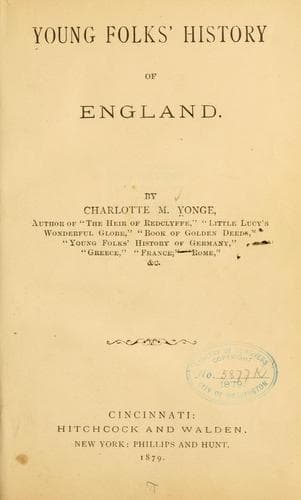
Young Folks' History of EnglandYonge, Charlotte M. (Charlotte Mary)
History
Young Folks' History of England
Yonge, Charlotte M. (Charlotte Mary)
Great Britain -- History -- Juvenile literature
Soon after this false plot, there was a real one called the Rye-house
Plot. Long ago, the king had pretended to marry a girl named Lucy
Waters and they had a son whom he had made Duke of Monmouth, but who
could not reign because there had been no right marriage. However,
Lord Russell and some other gentlemen, who ought to have know better,
so hated the idea of the Duke of York being king, that they joined in
the Ryehouse Plot for killing the duke, and forcing the king to make
Monmouth his heir. Some of the more unprincipled sort, who had joined
them, even meant to shoot Charles and James together on the way to the
Newmarket races. However, the plot was found out, and the leaders
were put to death. Lord Russell's wife, Lady Rachel, sat by him all
the time of his trial, and was his great comfort to the last. Monmouth
was pardoned, but fled away into Holland.
The best thing to be said of Charles II. was that he made good men
bishops, and he never was angry when they spoke out boldly about his
wicked ways; but then, he never tried to leave them off, and he spent
the very last Sunday of his life among his bad companions, playing at
cards and listening to idle songs. Just after this came a stroke of
apoplexy, and, while he lay dying on his bed, he sent for a Roman
Catholic priest, and was received into the Church of Rome, in which
he had really believed most of his life--though he had never dared to
own it, for fear of losing his crown. So, as he was living a lie, of
course the fruits showed themselves in his selfish, wasted life.
It was in this reign that two grand books were written. John Milton,
a blind scholar and poet, who, before he lost his sight, had been
Oliver Cromwell's secretary, wrote his Paradise Lost, or rather
dictated it to his daughters; and John Bunyan, a tinker, who had
been a Puritan preacher, wrote the Pilgrim's Progress.
CHAPTER XXXVIII.
JAMES II. A.D. 1685--1688.
James II. had, at least, been honest in openly joining the Church in
which he believed; but the people disliked and distrusted him, and he
had not the graces of his brother to gain their hearts with, but was
grave, sad, and stern.
Public-domain text, read in full here on John Shaqi.
Reviews
Reviews
No reviews yet
Be the first to share your thoughts on this work.
Elsewhere in the archive
Join the Discussion
Join the discussion
Sign in to leave a comment or review.
Sign InorCreate an account