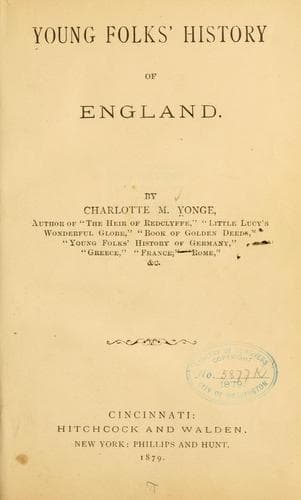
Young Folks' History of EnglandYonge, Charlotte M. (Charlotte Mary)
History
Young Folks' History of England
Yonge, Charlotte M. (Charlotte Mary)
Great Britain -- History -- Juvenile literature
We must think of the gentlemen, during these reigns, as going about
in very fine laced and ruffled coats, and the most enormous wigs.
You know the Roundheads had short hair and the Cavaliers long: so
people were ashamed to have short hair, and wore wigs to hide it if
it would not grow, till everybody came to have shaven heads, and
monstrous wigs in great curls on their shoulders: and even little
boys' hair was made to look as like a wig as possible. The barber
had the wig every morning to fresh curl, and make it white with hair
powder, so that everyone might look like an old man, with a huge
quantity of white hair.
CHAPTER XXXIX.
WILLIAM III. AND MARY II. 1689--1702.
When James II. proved to be entirely gone, the Parliament agreed to
offer the crown to William of Orange--the next heir after James's
children--and Mary, his wife, James's eldest daughter; but not until
there had been new conditions made, which would prevent the kings
from ever being so powerful again as they had been since the time of
Henry VII. Remember, Magna Carta, under King John, gave the power
to the nobles. They lost it by the wars of the Roses, and the Tudor
kings gained it; but the Stuart kings could not keep it, and the
House of Commons became the strongest power in the kingdom, by the
Revolution of 1688.
The House of Commons is made up of persons chosen--whenever there is
a general election--by the men who have a certain amount of property
in each county and large town. There must be a fresh election, or
choosing again every seven years; also, whenever the sovereign dies;
and the sovereign can dissolve the Parliament--that is, break it up--
and have a fresh election whenever it is thought right. But above the
House of Commons stands the House of Lords, or Peers. These are
not chosen, but the eldest son, or next heir of each lord, succeeds
to his seat upon his death; and fresh peerages are given as rewards
to great generals, great lawyers, or people who have deserved well of
their country. When a law has to be made, it has first to be agreed
to by a majority--that is, the larger number--of the Commons, then by
a majority of the Lords, and lastly, by the king or queen. The
sovereign's council are called the ministers, and if the Houses of
Parliament do not approve of their way of carrying on the government
they vote against their proposals, and this generally makes them
resign, that others may be chosen in their place who may please the
country better.
Public-domain text, read in full here on John Shaqi.
Reviews
Reviews
No reviews yet
Be the first to share your thoughts on this work.
Elsewhere in the archive
Join the Discussion
Join the discussion
Sign in to leave a comment or review.
Sign InorCreate an account