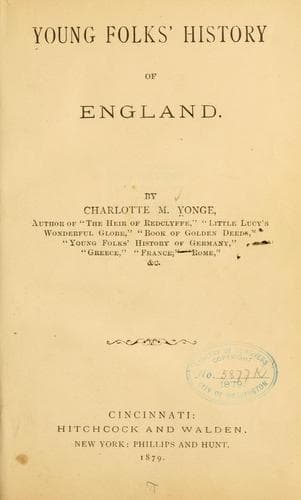
Young Folks' History of EnglandYonge, Charlotte M. (Charlotte Mary)
History
Young Folks' History of England
Yonge, Charlotte M. (Charlotte Mary)
Great Britain -- History -- Juvenile literature
This arrangement has gone on ever since William and Mary came in.
However, James II. still had many friends, only they had been out of
reach at the first alarm. The Latin word for James is Jacobus, and,
therefore, they were called Jacobites. All Roman Catholics were, of
course, Jacobites; and there were other persons who, though grieved
at the king's conduct, did not think it right to rise against him
and drive him away; and, having taken an oath to obey him, held that
it would be wrong to swear obedience to anyone else while he was
alive. Archbishop Sancroft was one of these. He thought it wrong
in the new queen, Mary, to consent to take her father's place; and
when she sent to ask his blessing, he told her to ask her father's
first, as, without that, his own would do her little good. Neither
he nor Bishop Ken, nor some other bishops, nor a good many more of
the clergy, would take the oaths to William, or put his name instead
of that of James in the prayers at church. They rather chose to be
turned out of their bishoprics and parishes, and to live in poverty.
They were called the non-jurors, or not-swearers.
Louis, King of France, tried to send James back, and gave him the
service of his fleet; but it was beaten by Admiral Russell, off Cape
La Hogue. Poor James could not help crying out, "See my brave English
sailors!" One of Charles's old officers, Lord Dundee, raised an army
of Scots in James's favor, but he was killed just as he had won the
battle of Killicrankie; and there was no one to take up the cause just
then, and the Scotch Whigs were glad of the change.
Most of James's friends, the Roman Catholics, were in Ireland, and
Louis lent him an army with which to go thither and try to win his
crown back. He got on pretty well in the South, but in the North--
where Oliver Cromwell had given lands to many of his old soldiers--
he met with much more resistance. At Londonderry, the apprentice boys
shut the gates of the town and barred them against him. A clergyman
named George Walker took the command of the city, and held it out for
a hundred and five days against him, till everyone was nearly starved
to death--and at last help came from England. William himself came
to Ireland, and the father and son-in-law met in battle on the banks
of the Boyne, on the 1st of July, 1690. James was routed; and large
numbers of the Irish Protestants have ever since kept the 1st of July
as a great holiday--commemorating the victory by wearing orange lilies
and orange-colored scarfs.
Public-domain text, read in full here on John Shaqi.
Reviews
Reviews
No reviews yet
Be the first to share your thoughts on this work.
Elsewhere in the archive
Join the Discussion
Join the discussion
Sign in to leave a comment or review.
Sign InorCreate an account