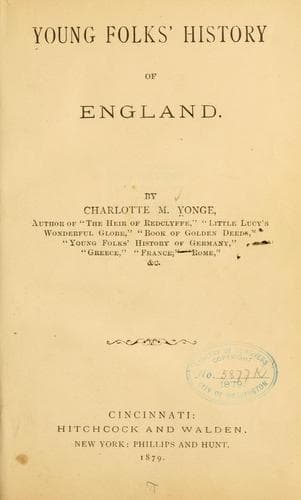
Young Folks' History of EnglandYonge, Charlotte M. (Charlotte Mary)
History
Young Folks' History of England
Yonge, Charlotte M. (Charlotte Mary)
Great Britain -- History -- Juvenile literature
Queen Anne, the second daughter of James II., began to reign on the
death of William III. She was a well-meaning woman, but very weak
and silly; and any person who knew how to manage her could make her
have no will of her own. The person who had always had such power
over her has Sarah Jennings, a lady in her train, who had married an
officer named John Churchill. As this gentleman had risen in the
army, he proved to be one of the most able generals who ever lived.
He was made a peer, and, step by step, came to be Duke of Marlborough.
It was he and his wife who, being Whigs, had persuaded Anne to desert
her father; and, now she was queen, she did just as they pleased.
The duchess was mistress of the robes, and more queen at home than
Anne was; and the duke commanded the army which was sent to fight
against the French, to decide who should be king of Spain. An
expedition was sent to Spain, which gained the rock of Gibraltar,
and this has been kept by the English ever since.
Never were there greater victories than were gained by the English
and German forces together, under the Duke of Marlborough and Prince
Eugene of Savoy, who commanded the Emperor's armies. The first and
greatest battle of them all was fought at Blenheim, in Bavaria, when
the French were totally defeated, with great loss. Marlborough was
rewarded by the queen and nation buying an estate for him, which was
called Blenheim, where woods were planted so as to imitate the
position of his army before the battle, and a grand house built and
filled with pictures recording his adventures. The other battles
were all in the Low Countries--at Ramillies, Oudenard, and Malplaquet.
The city of Lisle was taken after a long siege, and not a summer went
by without tidings coming of some great victory, and the queen going
in a state coach to St. Paul's Cathedral to return thanks for it.
But all this glory of her husband made the Duchess of Marlborough more
proud and overbearing. She thought the queen could not do without her,
and so she left off taking any trouble to please her; nay, she would
sometimes scold her more rudely than any real lady would do to any
woman, however much below her in rank. Sometimes she brought the poor
queen to tears; and on the day on which Anne went in state to St.
Paul's, to return thanks for the victory of Oudenarde, she was seen
to be crying all the way from St. James's Palace in her coach, with
the six cream-colored horses, because the duchess had been scolding
her for putting on her jewels in the way she liked best, instead of
in the duchess's way.
Public-domain text, read in full here on John Shaqi.
Reviews
Reviews
No reviews yet
Be the first to share your thoughts on this work.
Elsewhere in the archive
Join the Discussion
Join the discussion
Sign in to leave a comment or review.
Sign InorCreate an account